Receding Hairline Haircuts for Men Over 50
A receding hairline after 50 is not a personal failure, a punishment from the universe, or a sign you need to retreat into hats and denial.
It is biology, timing, and a long life lived. The good news is this: you have more good options than ever.
Modern men’s haircuts are no longer about pretending you have the same hair you did at 25. They are about working with what you have, projecting confidence, and choosing styles that feel intentional instead of apologetic.
If your hairline is beginning to move back at the temples, clearly thinning across the top, or the crown is starting to show.
This guide breaks down 10 realistic, flattering haircuts organised by hair type, what to tell your barber, which products actually work, and an honest look at hair transplants for men over 50.
Start Here: Know What You’re Working With
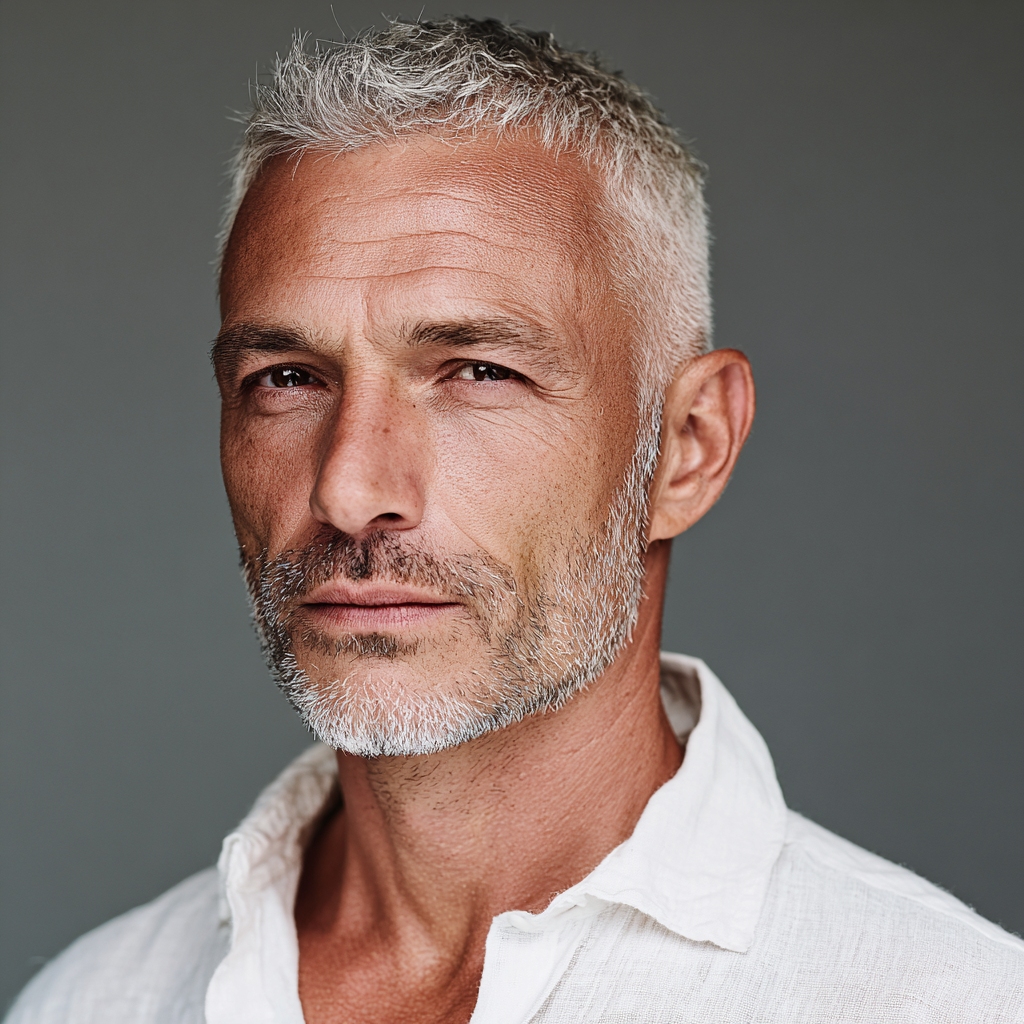
Not all receding hairlines are the same situation. Grouping them together is why so many men end up with the wrong cut. Before choosing a style, identify where you actually are.
Type A — Temples beginning to recede. The M-shape is just forming. The hairline is moving back at the corners but the front and crown are still intact. Most styles still work here. The priority is preventing contrast at the temples.
Type B — Clear frontal recession. The hairline has moved back noticeably. The M is defined. The crown is still good. This is the most common situation for men in their early 50s and the sweet spot for the most stylish options.
Type C — Diffuse thinning on top. Overall density is reducing across the entire top of the head. The hairline may still be defined but the hair itself is getting finer and lighter. Volume approaches stop working here.
Type D — Crown thinning. Thinning concentrated at the crown, sometimes with the front still relatively intact. This is a different problem that requires different cutting logic — covered in its own section below.
Type E — Heavy recession or very fine hair throughout. The recession is significant. Trying to preserve length creates contrast that works against you. The best options become architectural: buzz, crop, or shaved.
The Goal After 50: Reduce Contrast, Not Chase Volume
Most receding hairline mistakes come from one problem: too much contrast.
- Long hair on top with thinning density
- Sharp parts that expose recession
- Hard fades that draw attention upward
- Styles that require density you no longer have
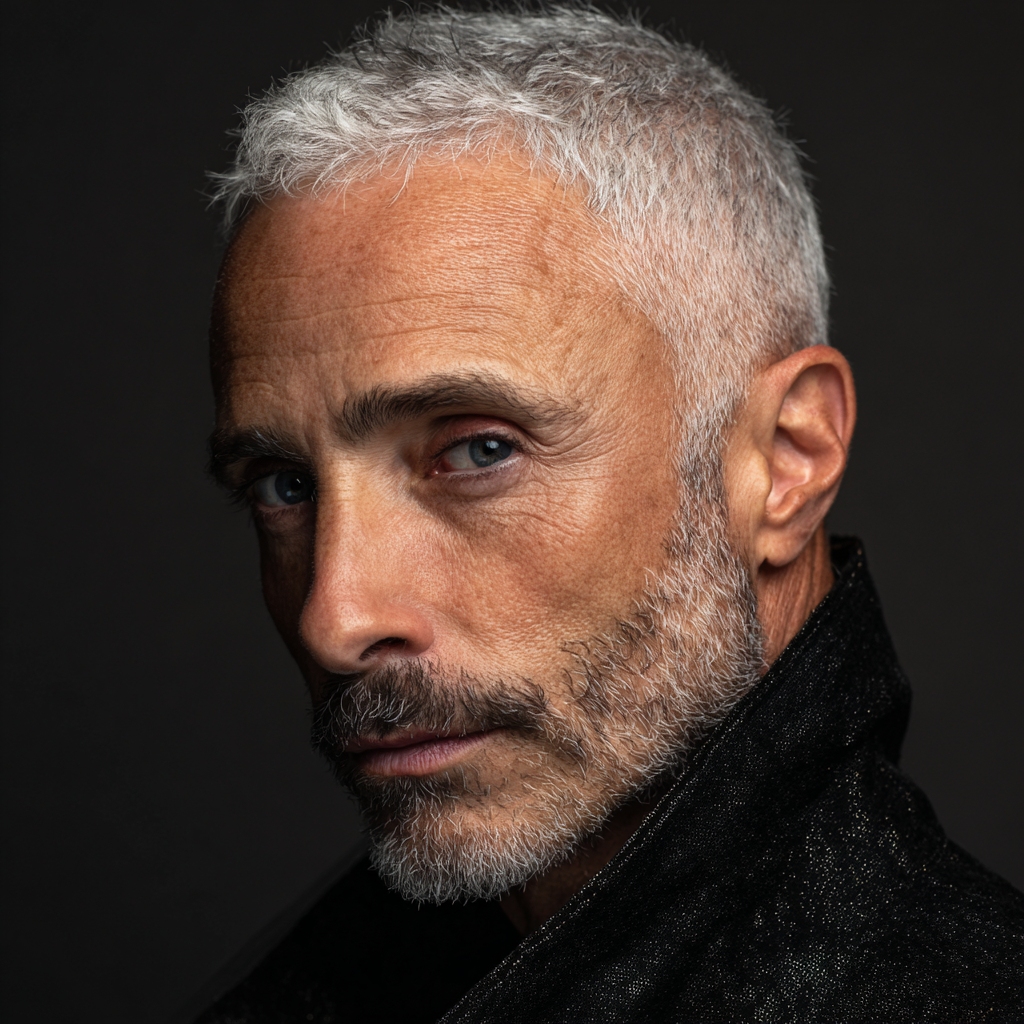
The fix is not shaving everything off unless you want to. The fix is choosing haircuts that:
- Keep length controlled
- Blend recession into the overall shape
- Focus on texture, not fullness
- Shift attention to structure and grooming
10 Best Haircuts for Men Over 50 With a Receding Hairline
1. The French Crop — Best for Type A and Type B
The French crop is one of the most underused haircuts for receding hairlines. It happens to be one of the most effective. A short fringe across the forehead does something clever: it reframes where the hairline sits. The eye reads the fringe, not the recession behind it.
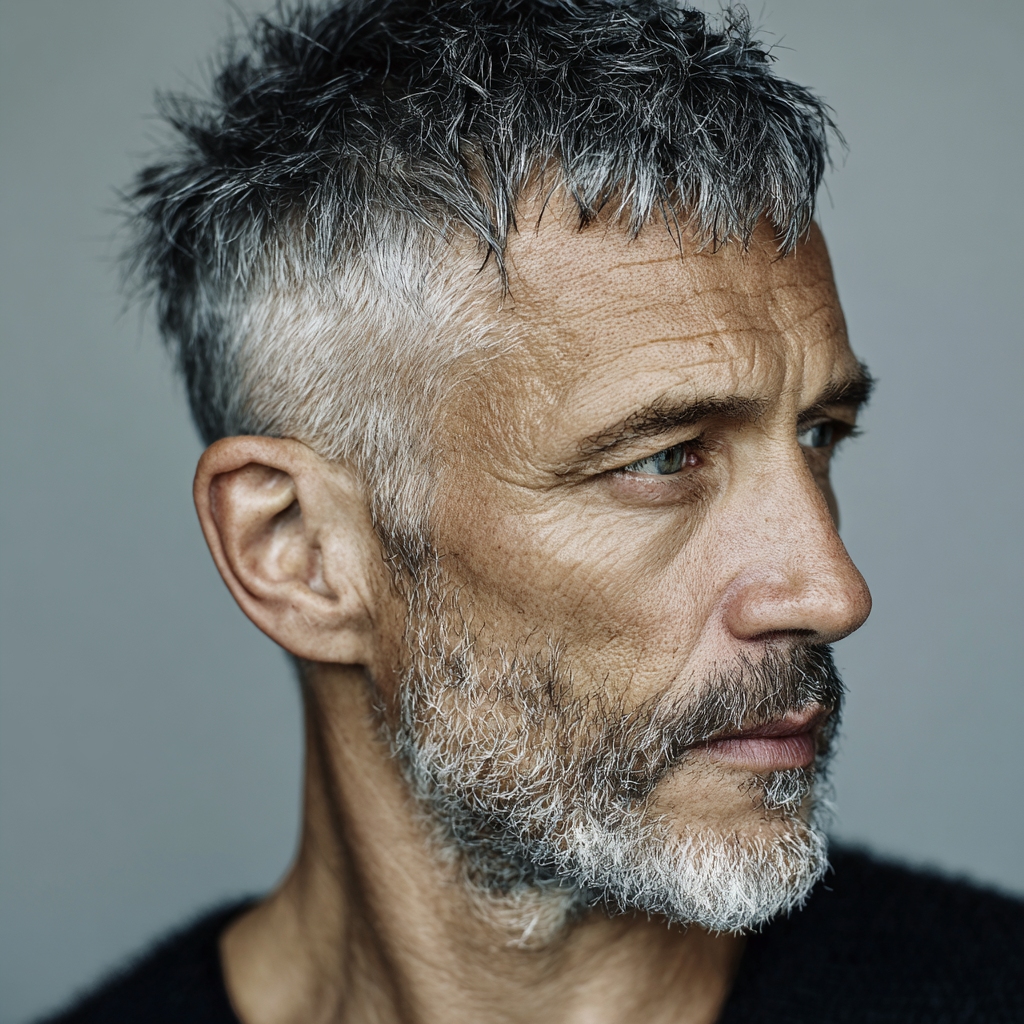
Why it works:
- The fringe draws attention forward and down, away from temples
- Short, textured top keeps density low so thinning is not exposed
- Soft taper on sides keeps the silhouette clean without hard contrast
Best for: Type A and Type B. Oval, square, and rectangular face shapes. Men who want something modern without going too short.
What to tell your barber: “Short French crop, about an inch on top, textured finish. Soft taper on the sides. No hard line on the fringe, keep it broken and natural.”
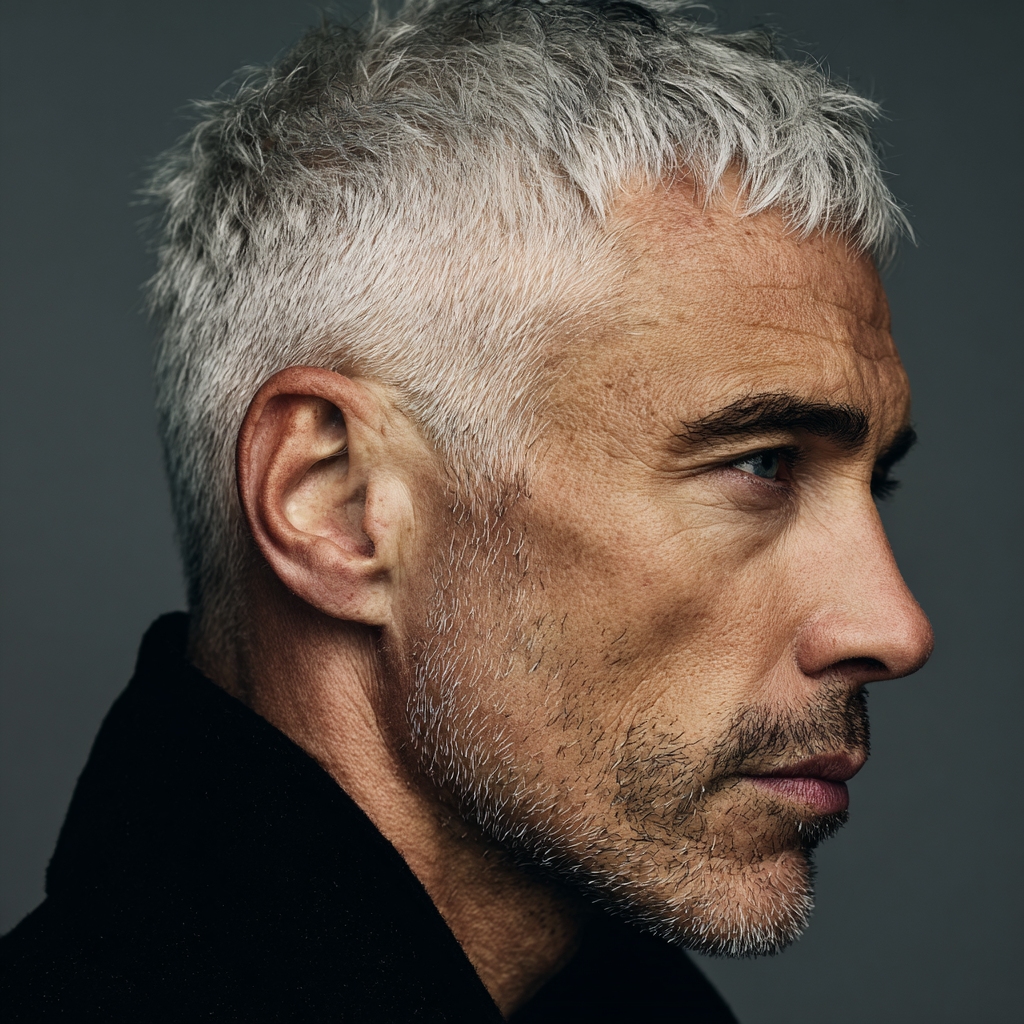
Styling tip: Work a small amount of hair fiber (similar to hair gel with high hold and low shine) through damp hair, then use your fingers to push slightly forward. Matte finish, no shine.
2. The Short Quiff — Best for Type A and Type B
This is not the rigid, product-heavy quiff of the 1980s. There is no hard shape, no lacquer, no comb. This is a short, natural lift. It leaves the hair moving loosely upward and slightly forward with texture and movement.
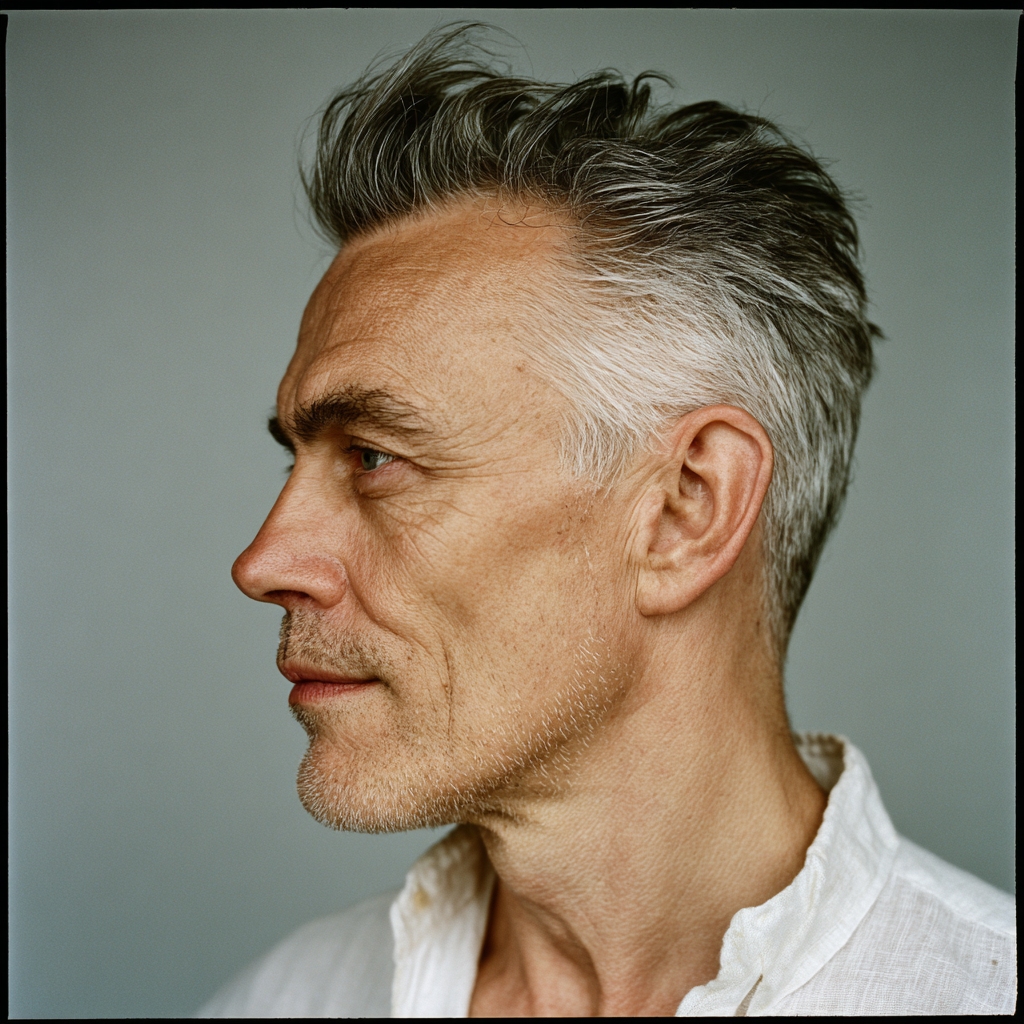
It works at Type A and early Type B because there is still enough density on top to carry the lift. Once thinning becomes diffuse, the quiff starts to expose rather than flatter. The height creates contrast with thinner patches. Keep it short, and it stays honest.
Why it works:
- Short height disguises early temple recession by drawing the eye upward and forward
- Avoids the flat, scalp-hugging look that makes thinning obvious
- Works particularly well with salt-and-pepper and silver hair which adds natural texture
Best for: Type A and Type B. Oval and square face shapes. Men who want some movement and personality without committing to a longer style.
What to tell your barber: “Short quiff, about an inch and a half on top, textured finish. Soft taper on the sides, not a fade. I want a natural lift, not a hard shape.”
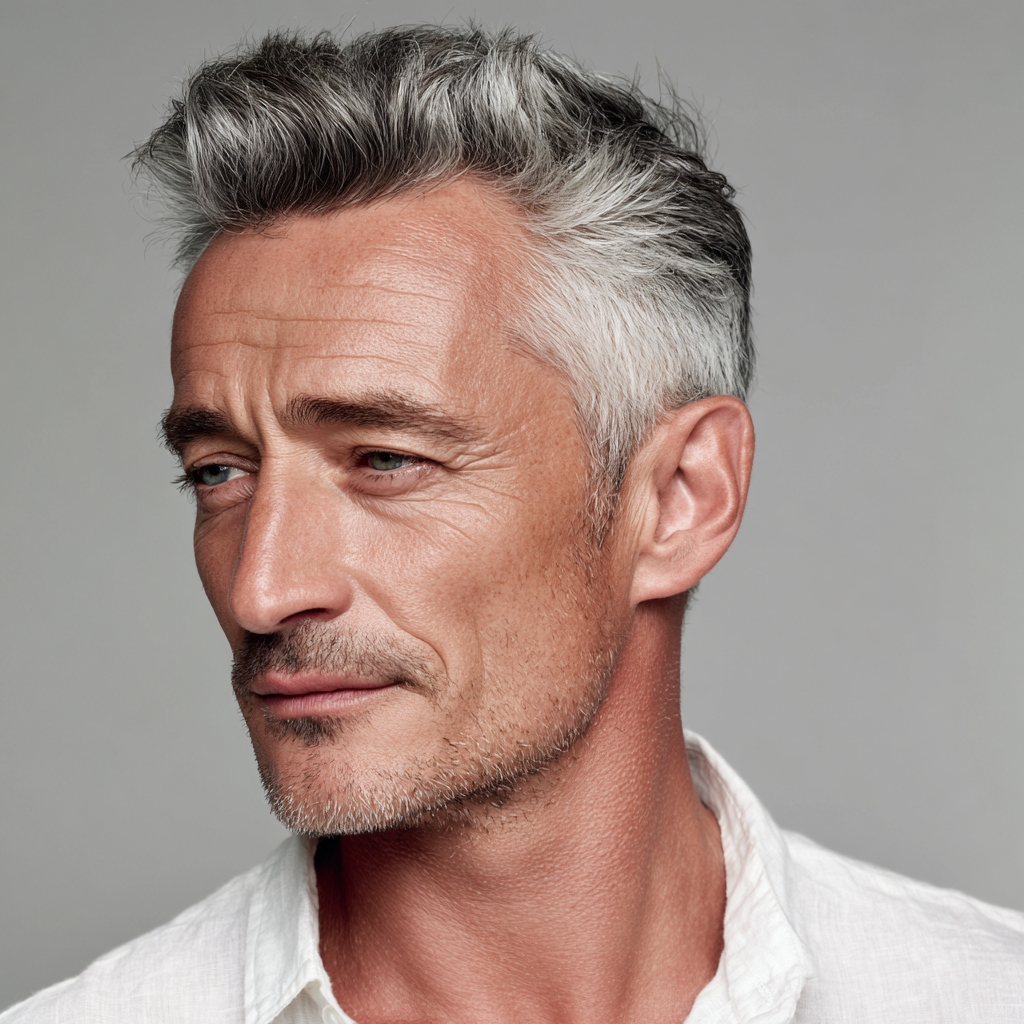
Styling tip: Use a dry shampoo paste that works through dry hair, giving grip and natural lift without shine or weight. Finish by running fingers upward.
3. The Short Textured Crop — Best for Type B and Type C
This is one of the most reliable haircuts for thinning or very fine hair. Short enough to eliminate the contrast problem, textured enough to look like a choice.
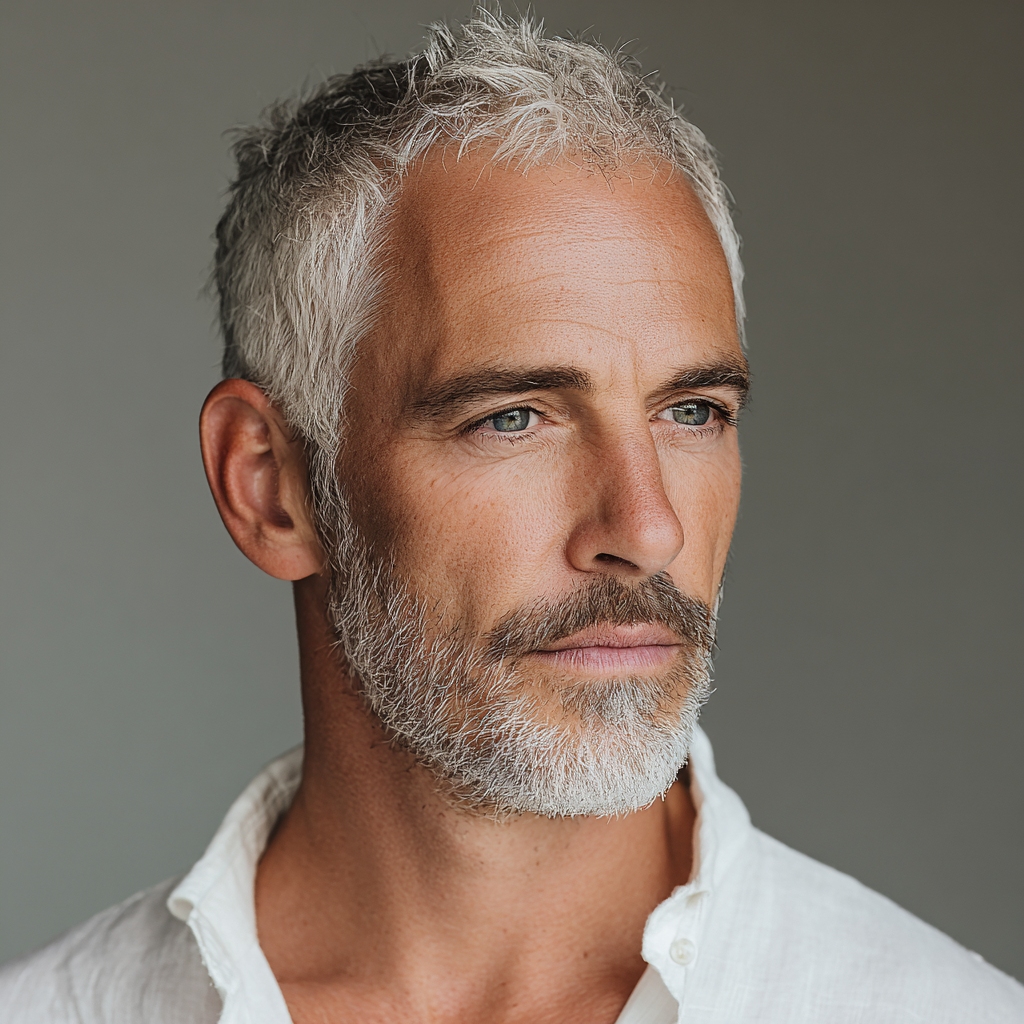
Why it works:
- Texture breaks up the hairline visually
- Short length reduces the appearance of thin spots
- No sharp part or exposed scalp lines
Best for: Type B and Type C. All face shapes. Men who want something modern and low-maintenance without going as short as a buzz.
What to tell your barber: “Short crop on top — about three-quarters of an inch, textured. Soft taper on the sides. No fade line, no hard part. I want it to look like it has texture without obvious product.”
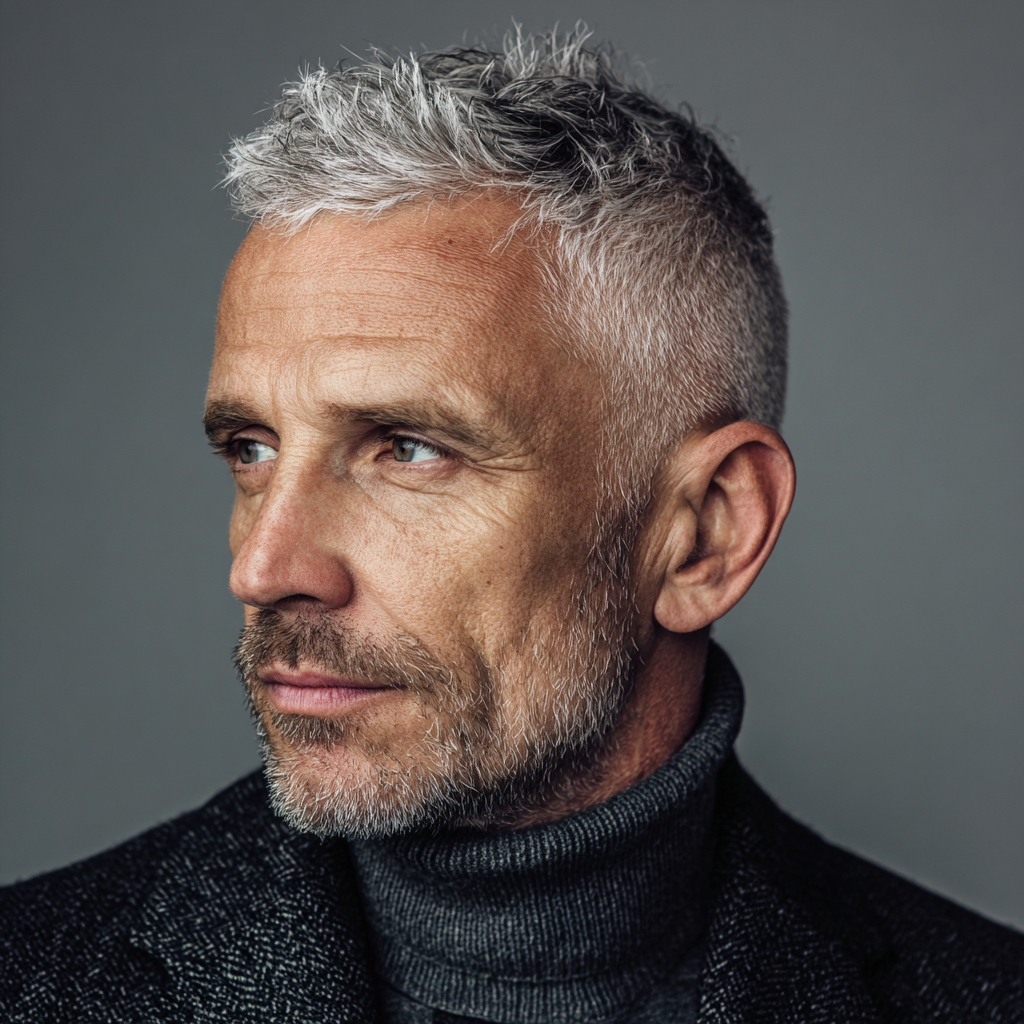
Styling tip: Use clay pomade — matte finish, medium hold. A pea-sized amount through towel-dried hair, styled with fingers.
4. The Classic Taper — Best for Type B and Type C
A taper haircut is softer than a fade and far more forgiving for mature hairlines. Where a fade creates a sharp gradient that pulls the eye toward the top of the head, a taper blends gradually and keeps the silhouette calm.
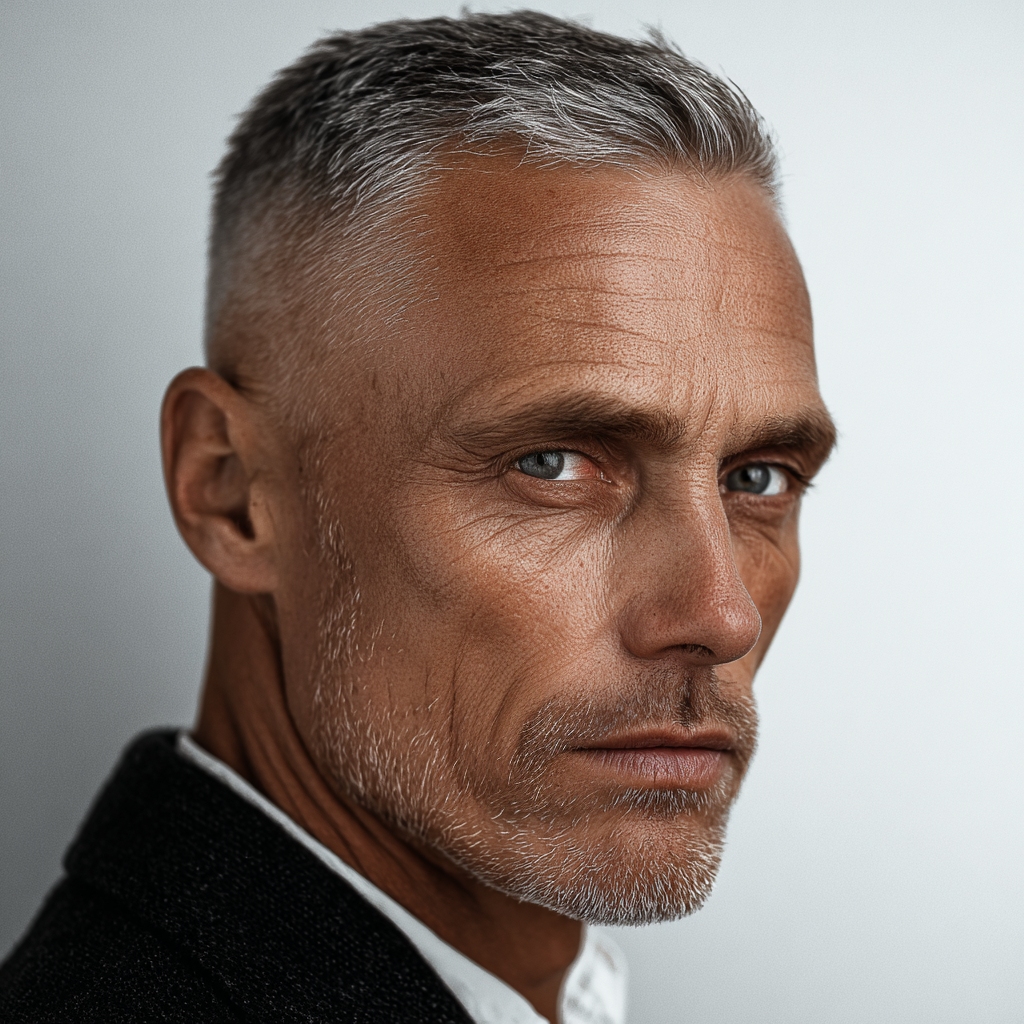
Why it works:
- Keeps the silhouette clean without drama
- Avoids dramatic contrast between sides and top
- Frames the face without highlighting recession
Best for: Type B and Type C. Men with thinning but reasonably even coverage. Conservative or professional environments. Gray or salt-and-pepper hair.
What to tell your barber: “Classic taper — not a fade. Keep about an inch and a half on top, tapered naturally on the sides down to the skin at the neck. No hard lines. I want it to look tailored, not trendy.”
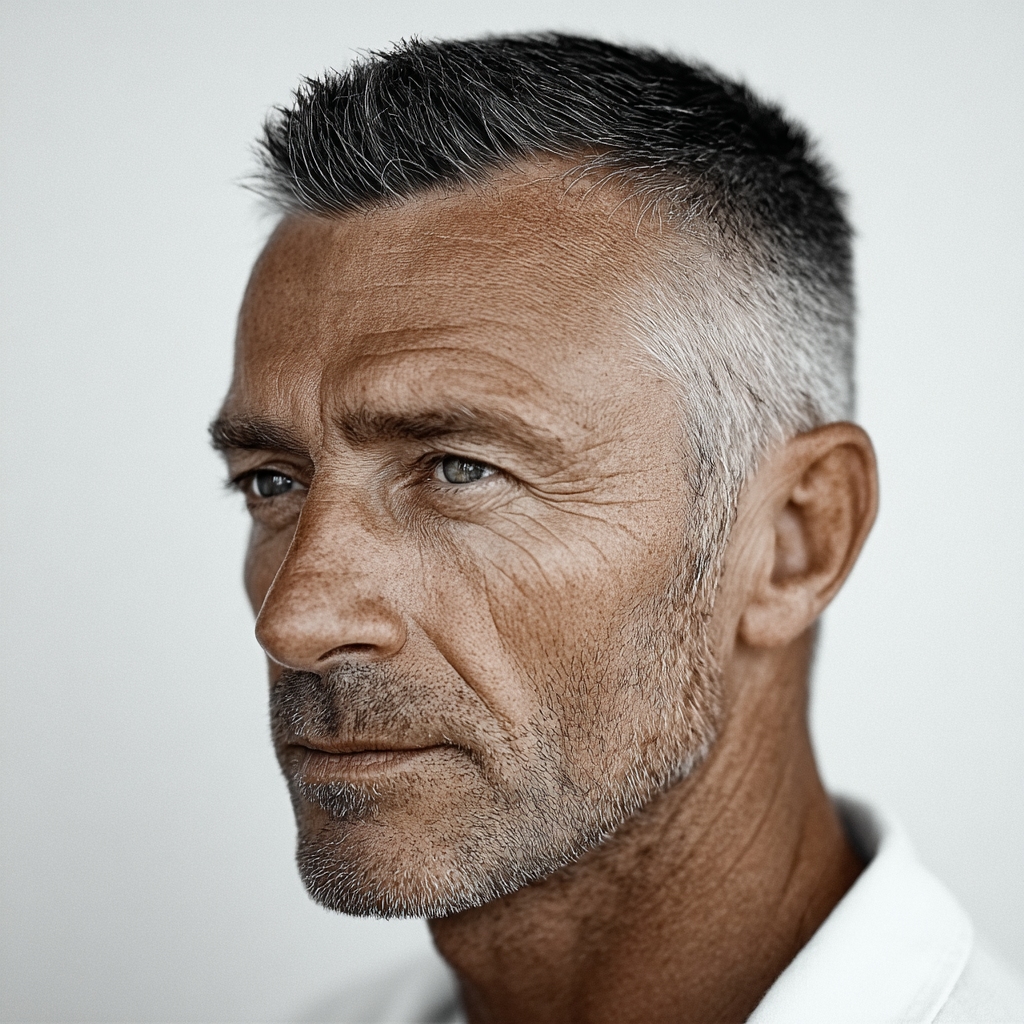
Styling tip: Hair cream with light hold, adds texture without volume or shine. Works especially well on fine gray hair.
5. The Ivy League — Shorter, Softer — Best for Type A and Type B
The Ivy League still works after 50, but only if it is adjusted. The updated version is shorter, looser, and moves forward rather than back.
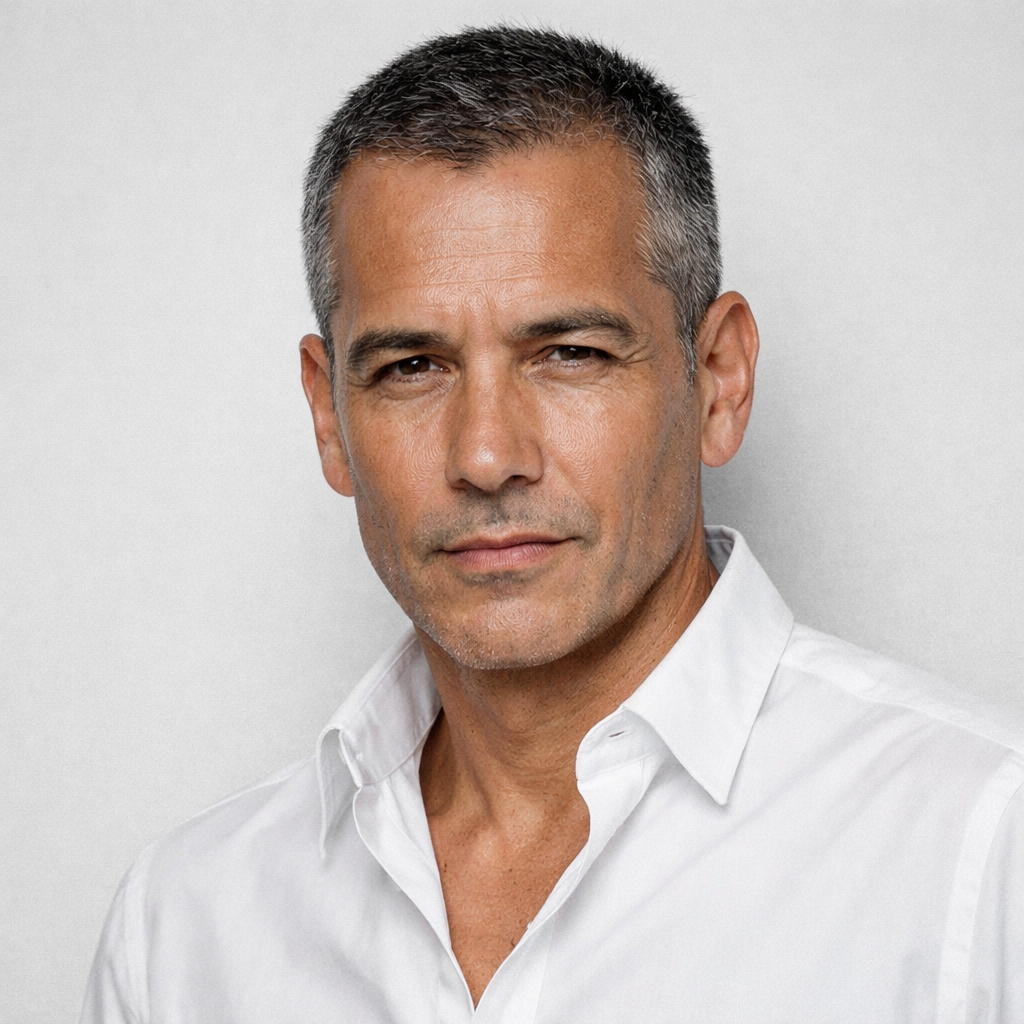
Key rules:
- Keep it shorter than you think — no more than an inch and a half on top
- No hard side part
- Slight forward movement instead of slicking back
Best for: Type A and early Type B. Oval and square faces. Professional environments where a French crop might feel too casual.
What to tell your barber: “Short Ivy League — keep the top around an inch and a half. No hard part. Soft taper on the sides. I want it to sit forward and slightly to the side naturally, not swept back.”
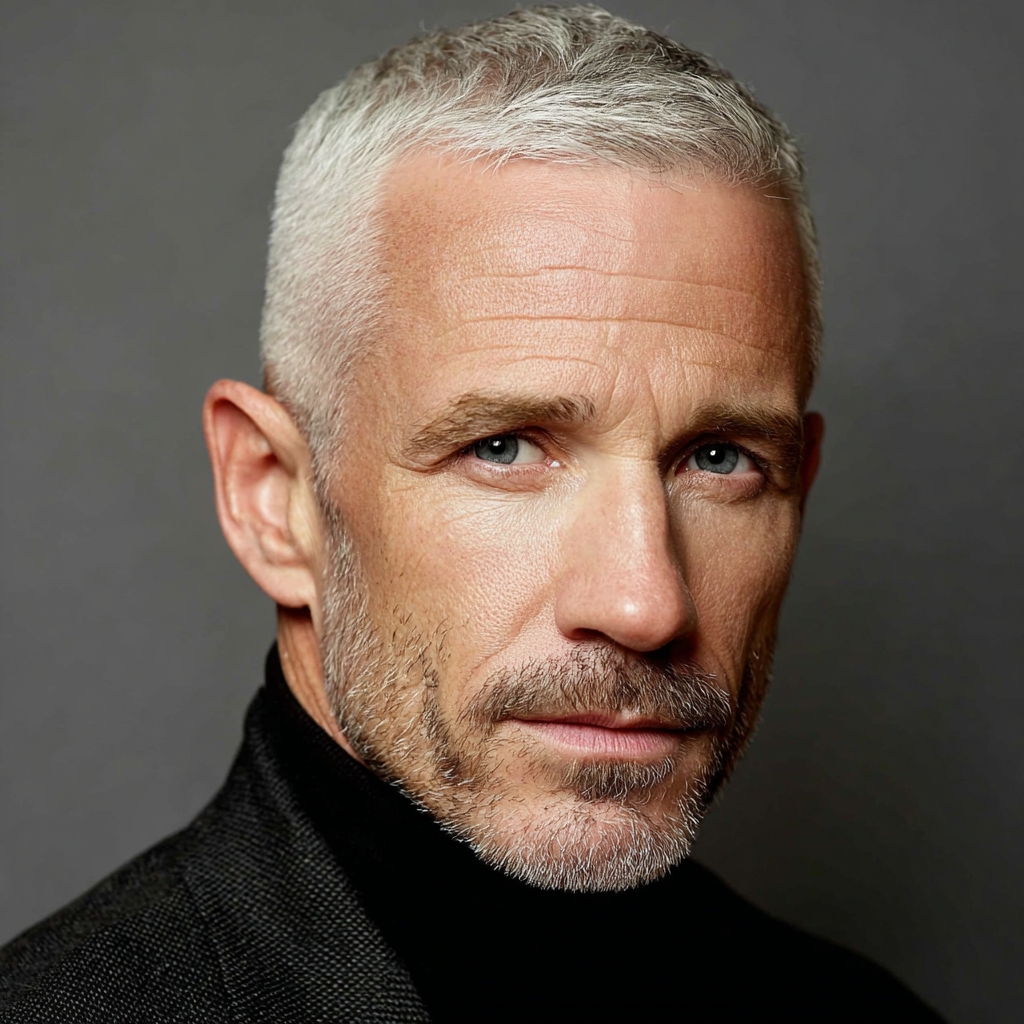
Styling tip: Forming Cream — light to medium hold, natural finish. Apply to damp hair and work forward with the palm.
6. The Comb-Forward — Best for Type B and Type C
Not a comb-over. Not even close. The comb-forward uses natural hair direction to move weight toward the front of the head, filling the hairline from above rather than sweeping from the side.
When done right, it is one of the most flattering options for men with significant frontal recession who still want some length.
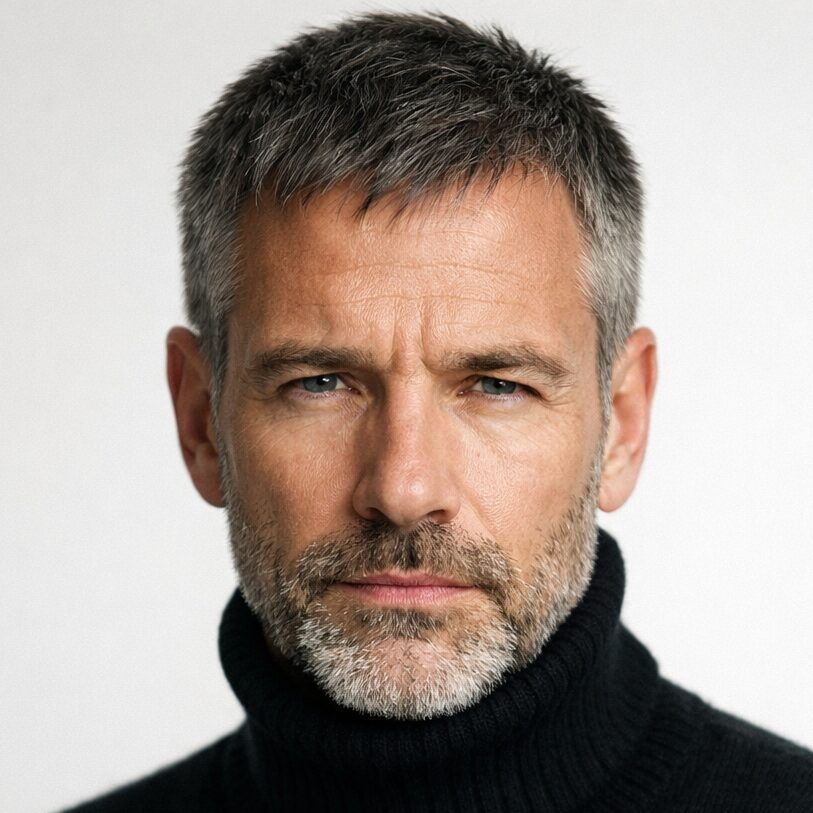
The key is keeping it short enough that there is nothing to hide, just texture moving naturally forward.
Why it works:
- Creates soft visual density at the hairline
- Works with fine hair better than against it
- No part means no exposed scalp line
Best for: Type B and Type C. Round and oval faces. Men with fine but evenly distributed remaining hair.
What to tell your barber: “Short on top — about three-quarters to an inch. I want a comb-forward direction, not a side part. Soft taper on the sides. Textured finish, nothing slick.”
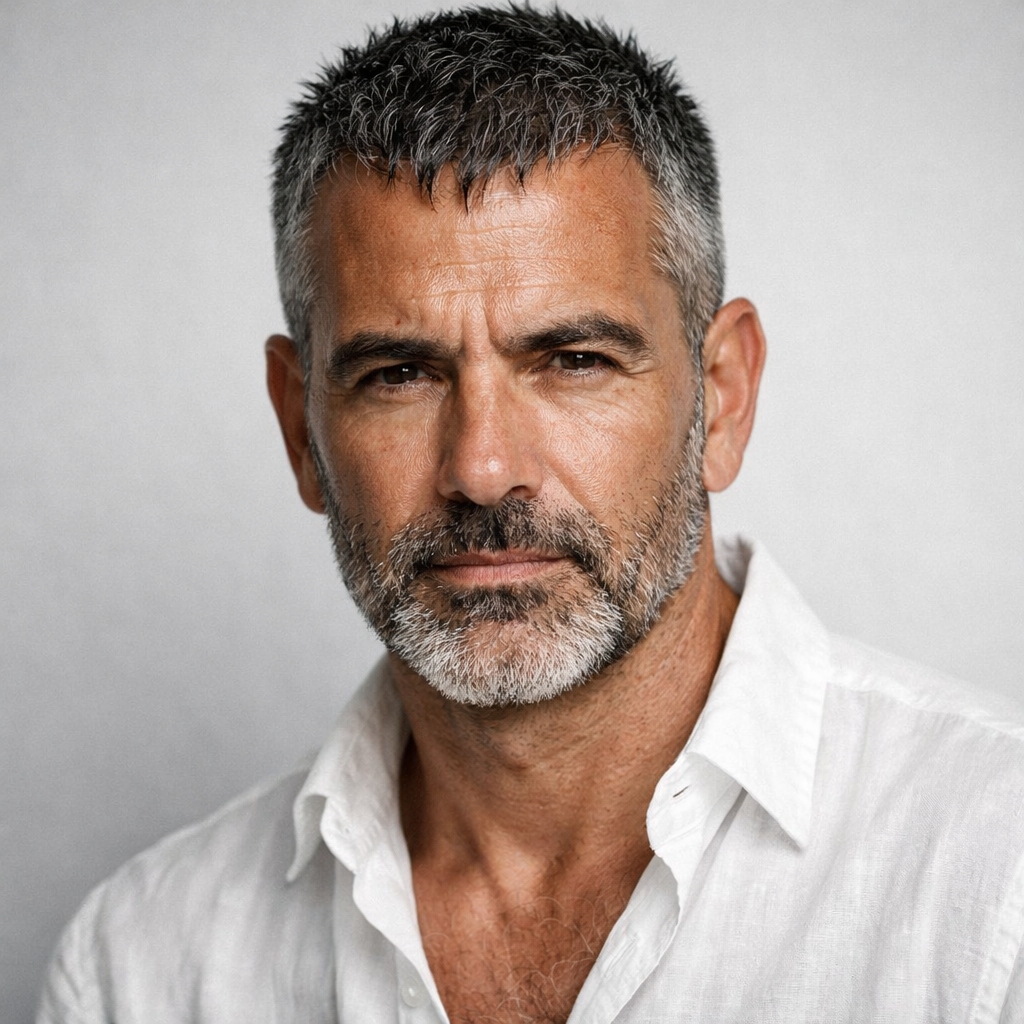
Styling tip: Volumising Shampoo used regularly, then Sea Salt Spray on damp hair before blow-drying forward with fingers.
7. The Caesar Cut — Best for Type C
The Caesar cut is having a quiet comeback, and for good reason. A short, horizontal fringe across the forehead creates a strong visual line that resets where the face begins.
For men with diffuse thinning across the top, it is one of the few styles that actually addresses the problem rather than trying to obscure it.
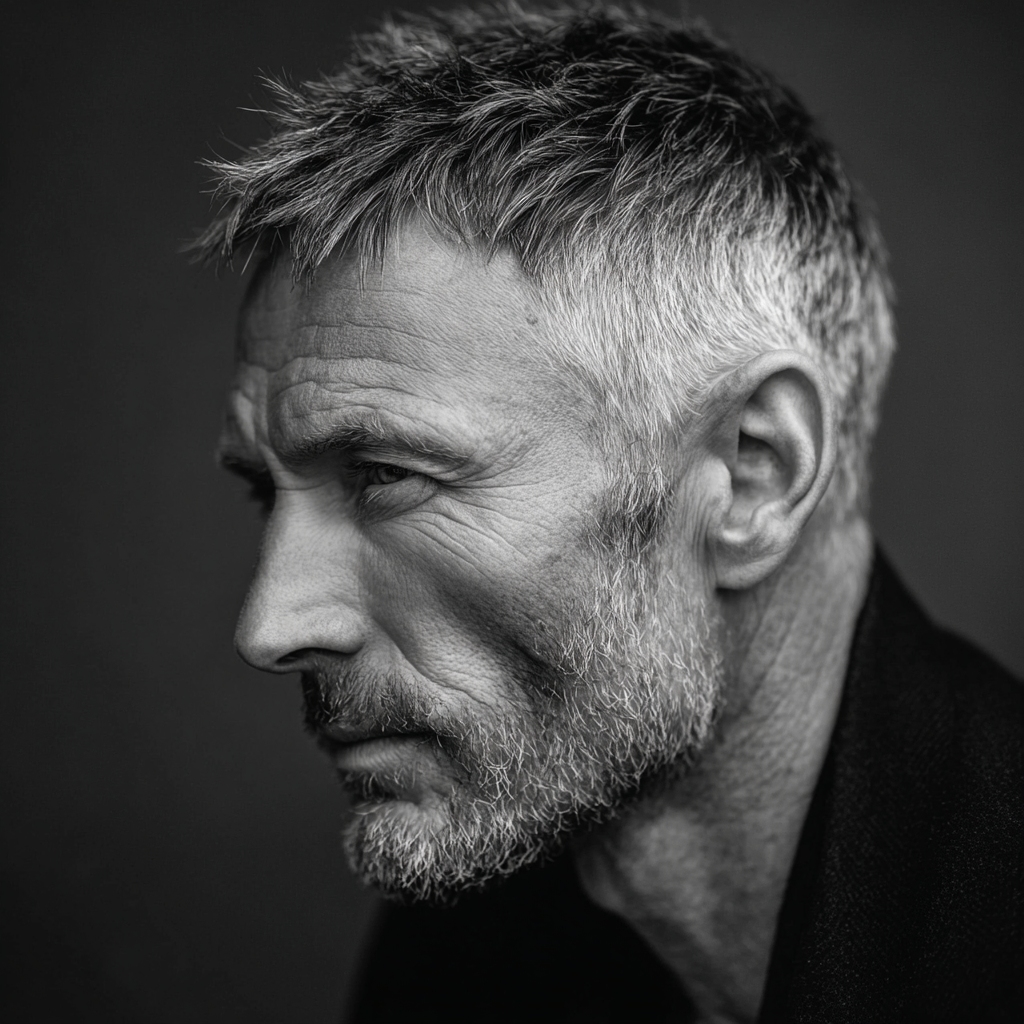
The modern version is not the 1990s version. It is shorter, more textured, and paired with a soft taper rather than a hard undercut.
Why it works:
- Even length all over reduces contrast from thinning spots
- The fringe creates a deliberate front line that owns the hairline
- Minimal styling required
Best for: Type C. Square and oval faces. Men who want a structured look without going all the way to a buzz.
What to tell your barber: “Modern Caesar — half an inch to three-quarters all over the top with a soft horizontal fringe. Tapered sides, not faded. I want it textured, not flat.”
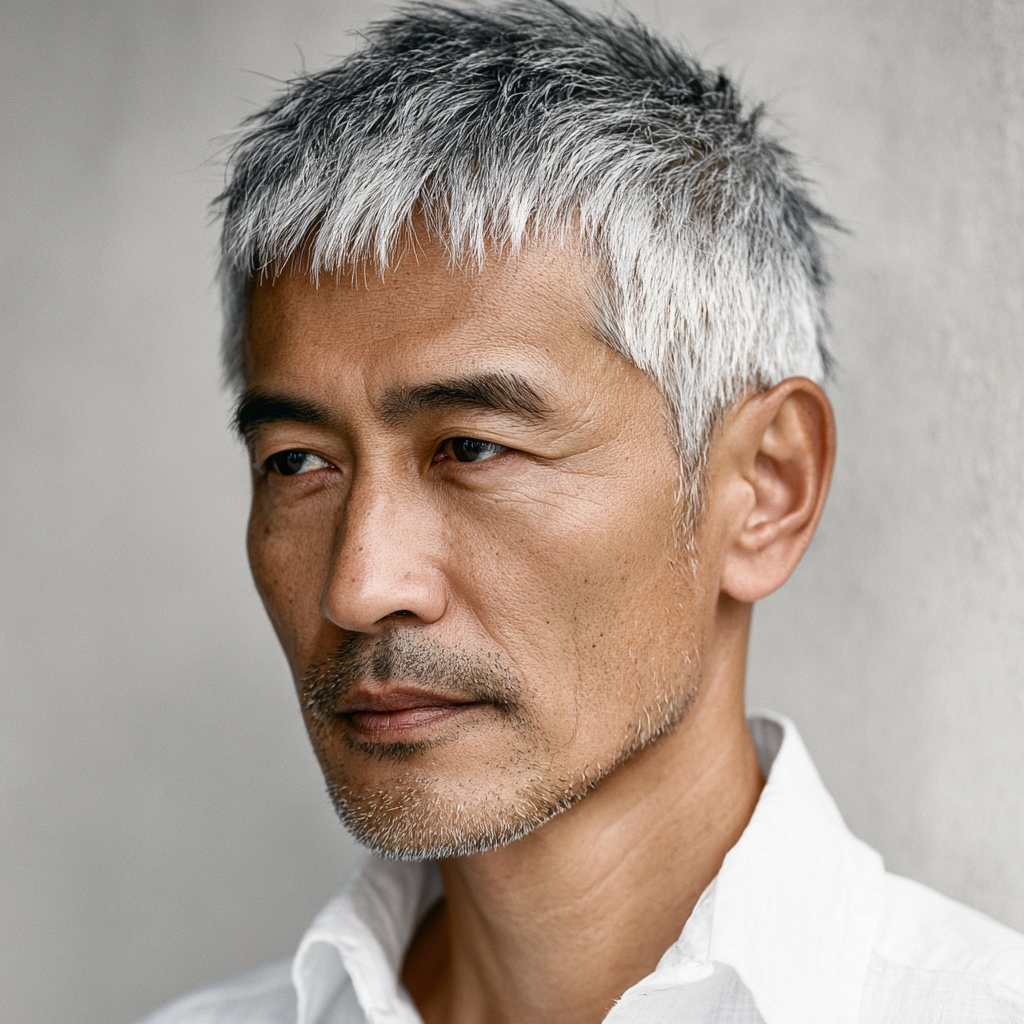
Styling tip: Texturizing Hair Powder — shake directly onto the roots for instant texture and thickness. Invisible finish.
8. Short Textured Crop with Beard — Best for Type B, C, and D
The beard changes everything. A well-groomed beard, full, trimmed, or close stubble shifts the visual weight of the face downward and draws attention away from the hairline entirely.
Paired with a short textured crop, it is one of the most complete and modern-looking combinations for men over 50.
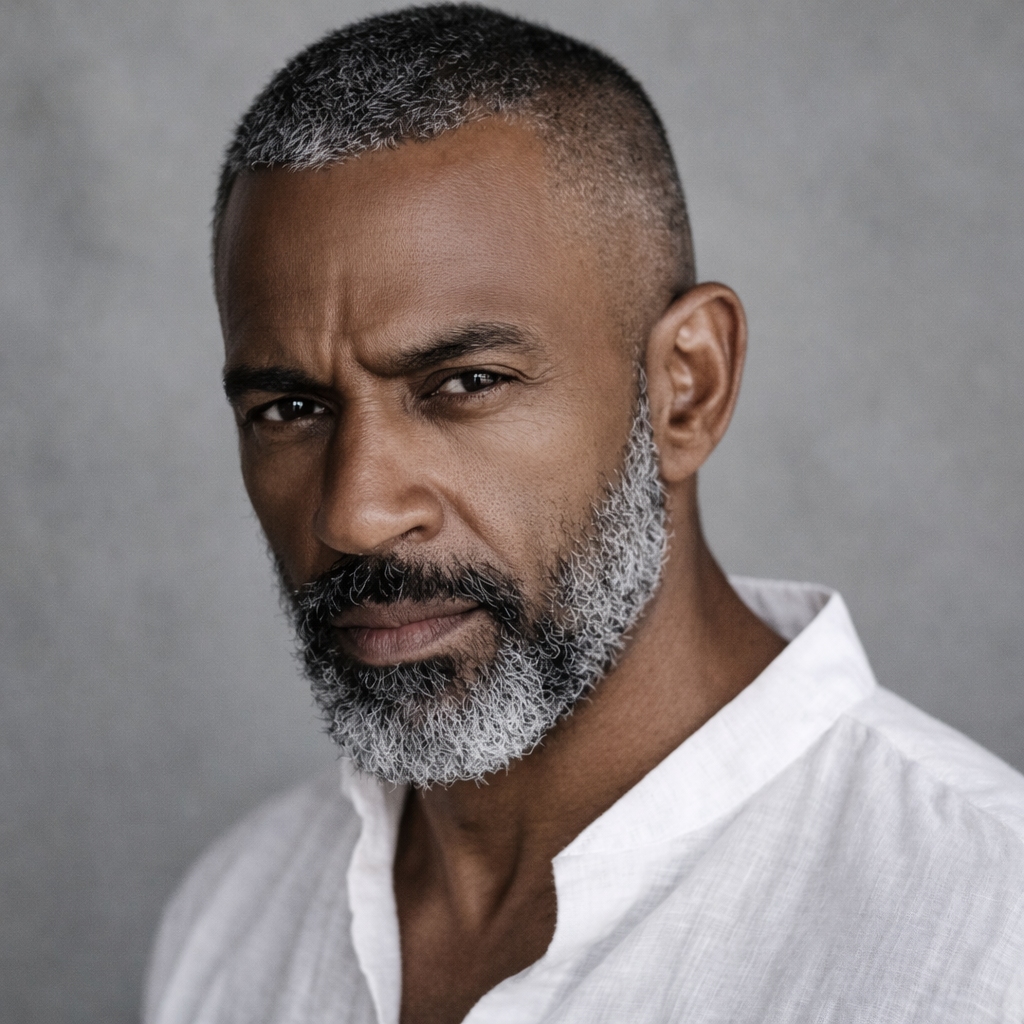
This is not about compensating. It is about framing. The beard creates a strong lower-face presence that makes the haircut feel intentional as part of a complete look.
Why it works:
- Beard weight below anchors the face so recession above reads as a style choice
- Salt-and-pepper beard with gray hair creates visual coherence
- Works across Type B, C, and D
Best for: Type B, C, and D. Most face shapes. Men who already have a beard or are open to growing one.
What to tell your barber: “Short textured crop on top, half an inch to three-quarters. Soft taper on the sides. And I want the beard shaped — keep the weight on the chin, clean the neckline hard.”
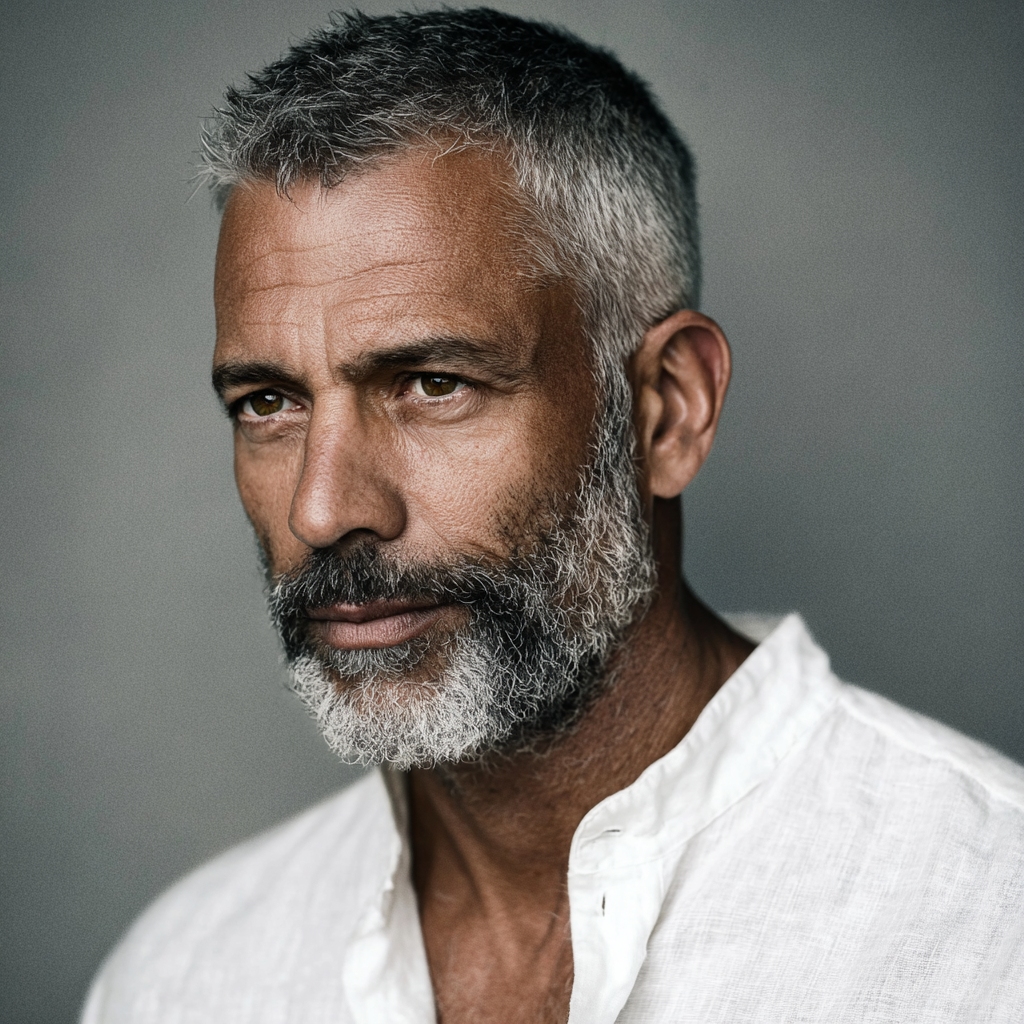
Styling tip: For the hair: Hair Texturizing with very light hold. For the beard: Beard Oil — light, non-greasy, keeps gray beard from looking dry or wiry.
9. The Buzz Cut — Best for Type D and Type E
The buzz cut is the option that surprises most men once they finally try it. What felt like surrender becomes liberation. The logic is simple: when contrast is the enemy, eliminate it entirely.
Why it works:
- Eliminates contrast almost completely
- Makes recession a bit irrelevant — there is not much to compare it to
- Emphasizes facial structure and bone
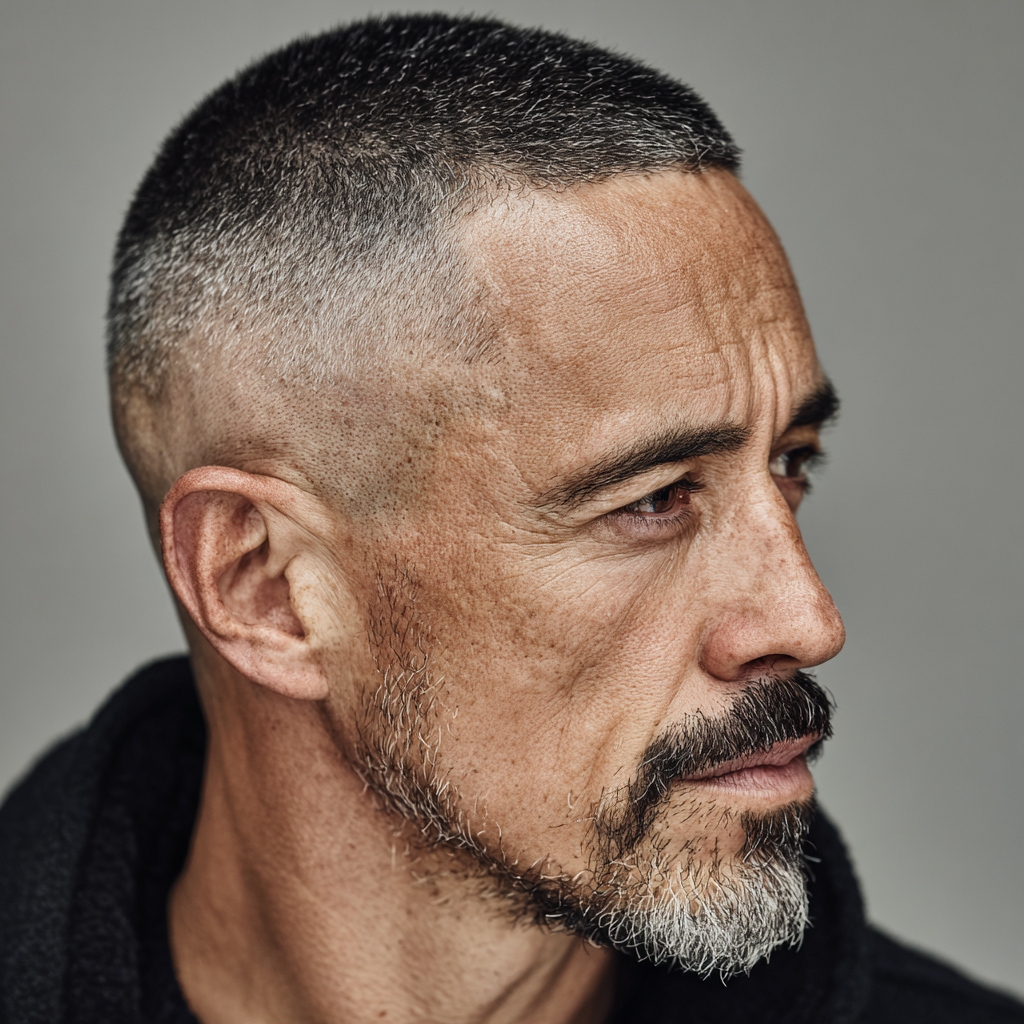
If your hair is very thin or the crown is thinning significantly, a buzz cut often looks dramatically better than trying to preserve length that has stopped cooperating.
Best for: Type D and Type E. Square, oval, and diamond face shapes respond best. If your face is very round, add stubble to add definition below.
What to tell your barber: “Guard number 2 all over — or a 1.5 on the sides blending to a 2 on top. Clean up the neck and around the ears. No fade line, just a consistent short length.”
Pair it with:
- A well-groomed beard or stubble
- Strong eyewear
- A consistent skincare routine — the buzz cut puts your skin front and centre
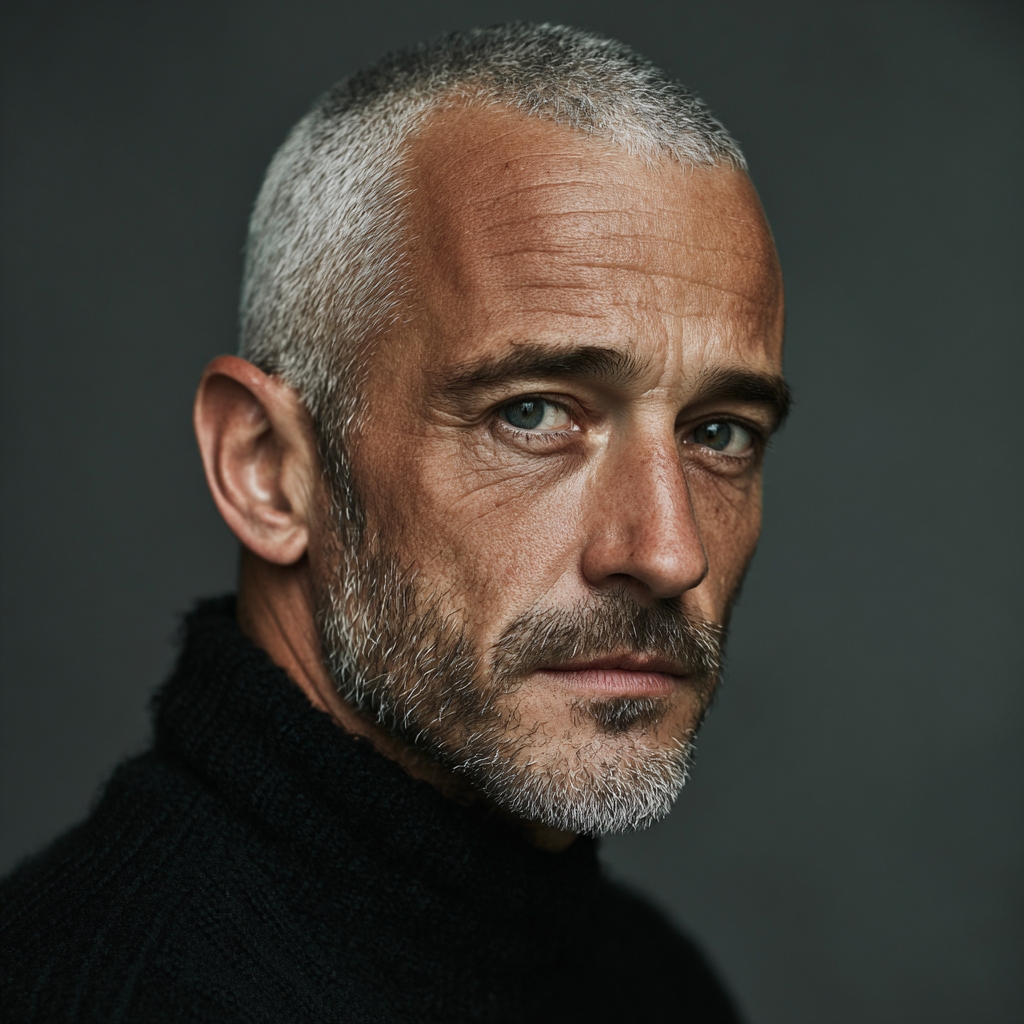
10. The Shaved Head and Induction Cut — Best for Type E
The induction cut, or 0 guard buzz cut, retains a trace of hair while eliminating all contrast problems.
The shaved head goes one step further. Smooth scalp, full commitment, nothing left to manage except everything else.
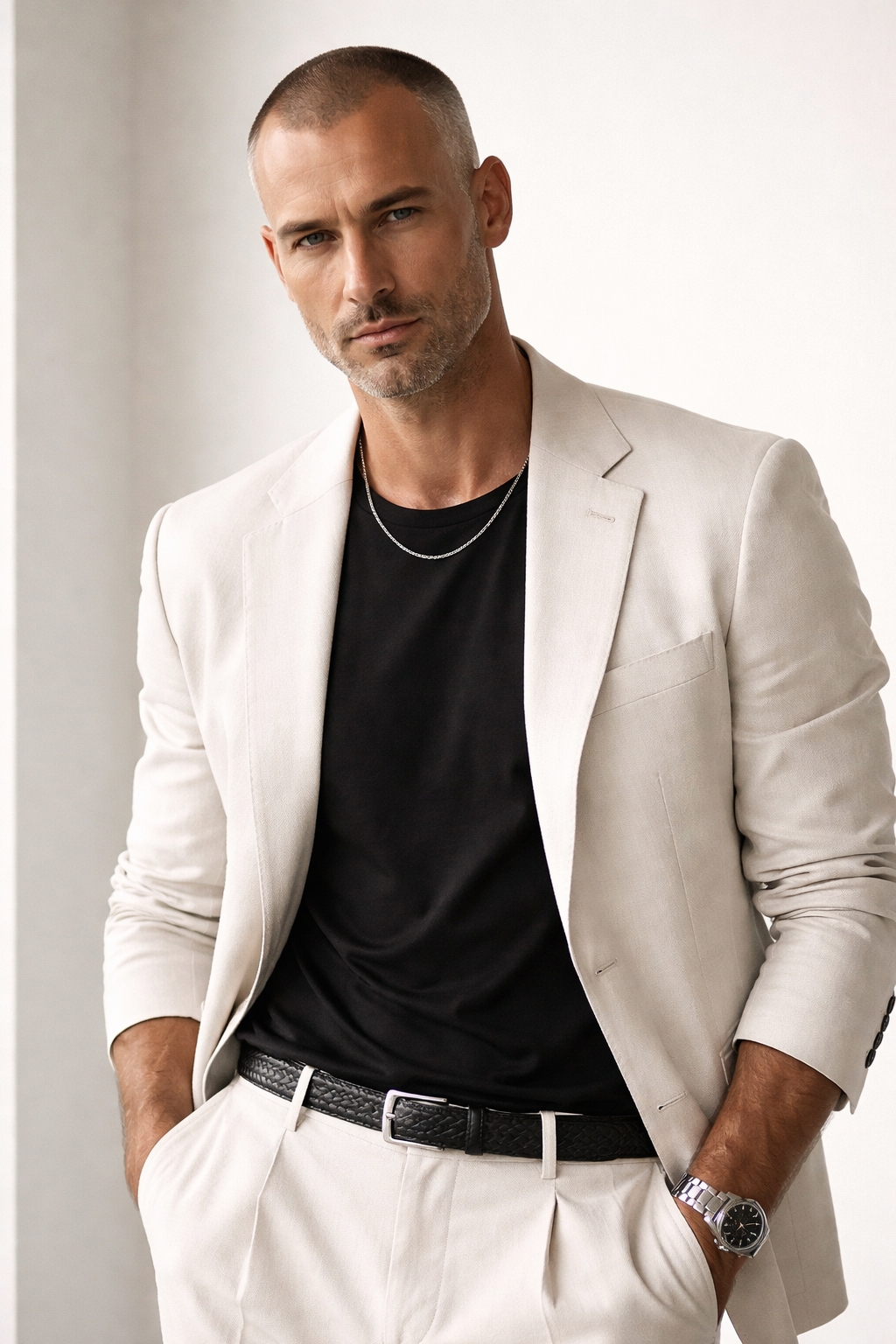
Both work. The induction cut suits men who want the result without the daily maintenance of a razor. The shaved head suits men who are done entirely with the conversation.
What works best alongside both:
- A well-shaped beard — it anchors the face and adds definition below
- Strong eyewear if you wear it
- A consistent skincare routine — exposed scalp needs SPF daily without exception
What to tell your barber: “Number 0 all over, uniform length, clean the neckline hard” — or for the full shave: “Foil shaver not a blade, smooth but not irritated. Shape the beard to compensate for any roundness.”
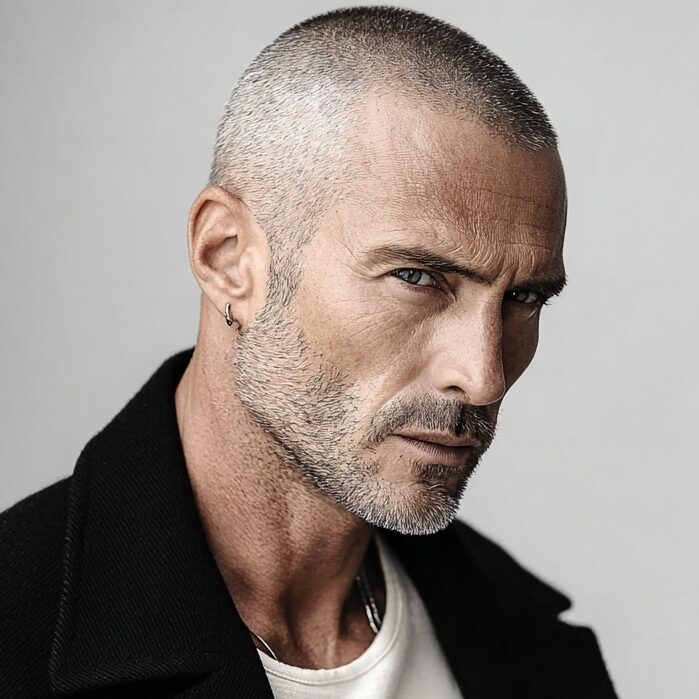
Styling tip: Daily Facial Cleanser on the scalp daily. Lab Series Moisturizer with SPF — a shaved or closely cropped head is a sun-exposed scalp. Do not skip this.
Crown Thinning Is a Different Problem
Crown thinning is a different problem. Unlike frontal recession, which you see every time you look in a mirror, crown thinning is the blind spot.
You often do not know how significant it is until you see a photograph or someone mentions it.
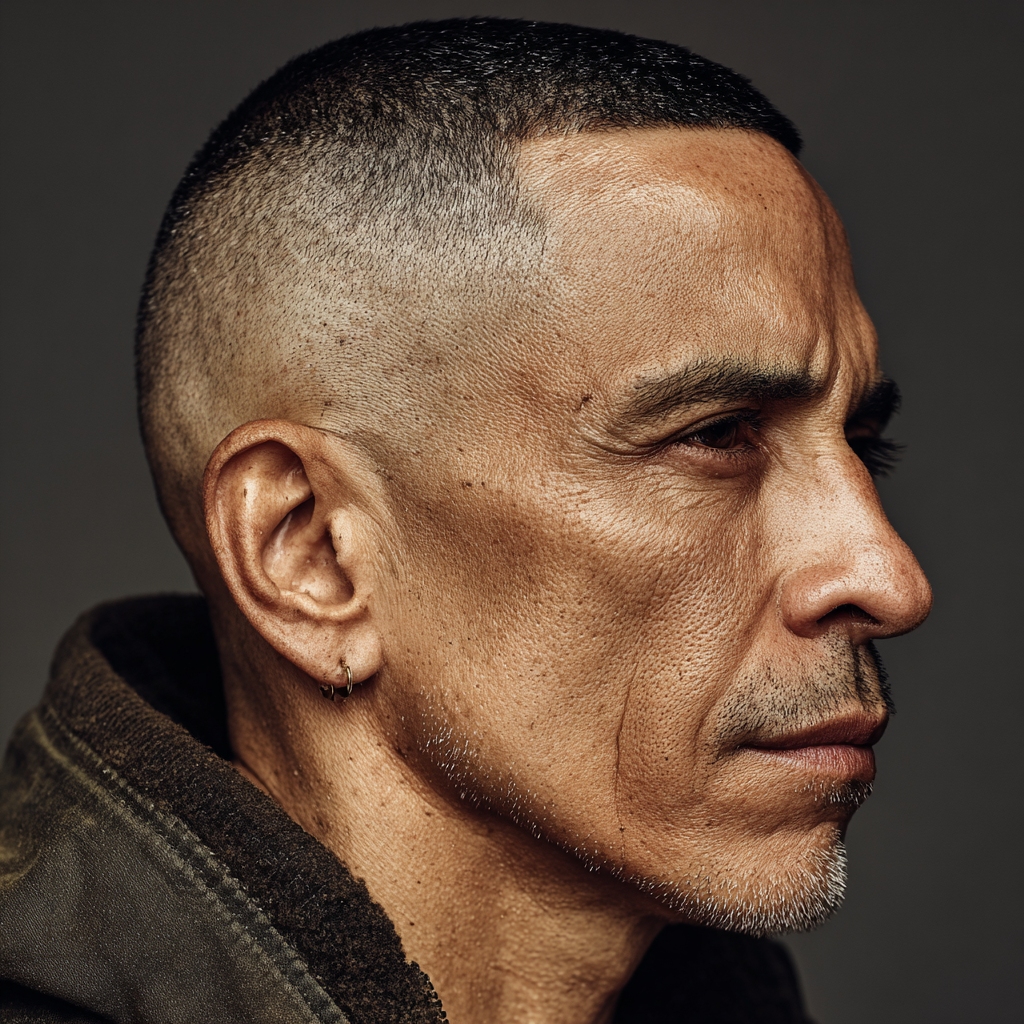
It also requires different cutting logic. Frontal recession is managed by framing and direction.
Crown thinning is managed by length distribution, texture placement at the vertex, and avoiding the gravity that pulls thin hair flat against the scalp at the crown.
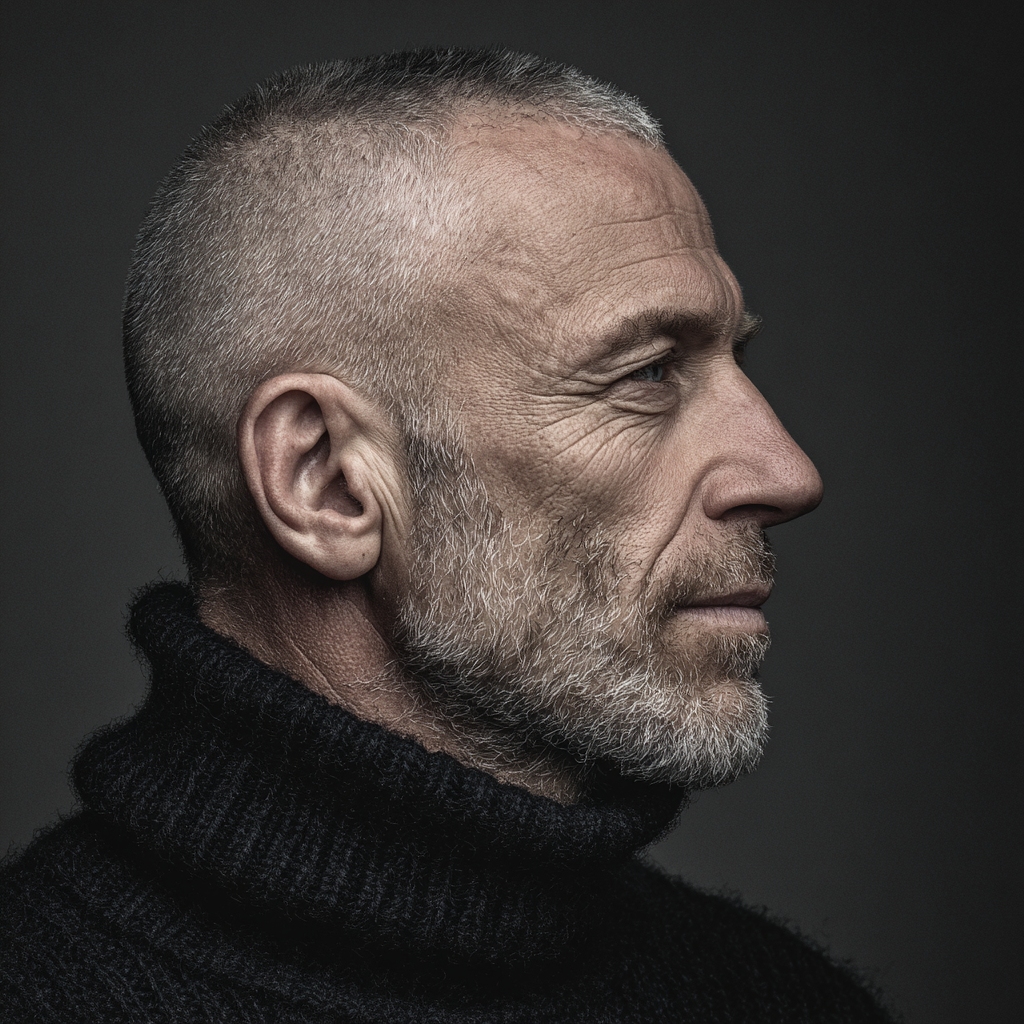
The short version: if your crown is thinning, avoid very long hair on top with short sides, this creates a tent effect that collapses over the crown and makes it more visible. A uniform short texture, crew cut, or buzz cut, tends to serve Type D best.
Styling Tips That Actually Help
- Use lightweight matte products, never greasy pomades — shine magnifies thinning
- Avoid combing straight back — this creates a long, exposed track of scalp
- Blow-dry with fingers, not a brush — brush styling flattens fine hair
- Dry shampoo at the roots adds lift and texture in under a minute
- Accept movement — rigid, sculpted hair shows thinning faster than natural texture
Your goal is not volume. Your goal is natural texture and control.
Embrace Texture Over Slickness
Slicked-back styles rarely work with thinning hair. They pull everything flat against the scalp and make thinning more obvious. Texture creates separation between strands, which reads as density even when density is what you have least of.
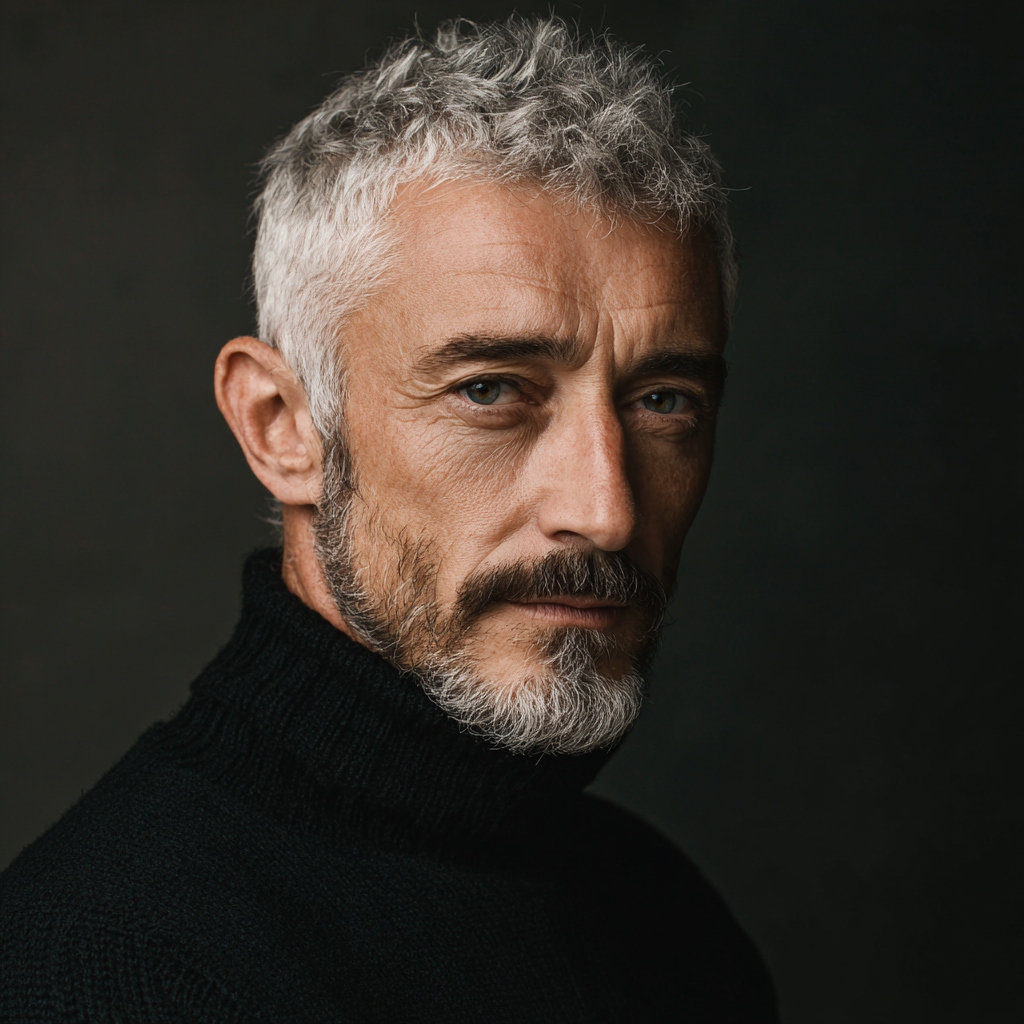
Explore More: Top 5 Textured Hairstyles for Men of All Time
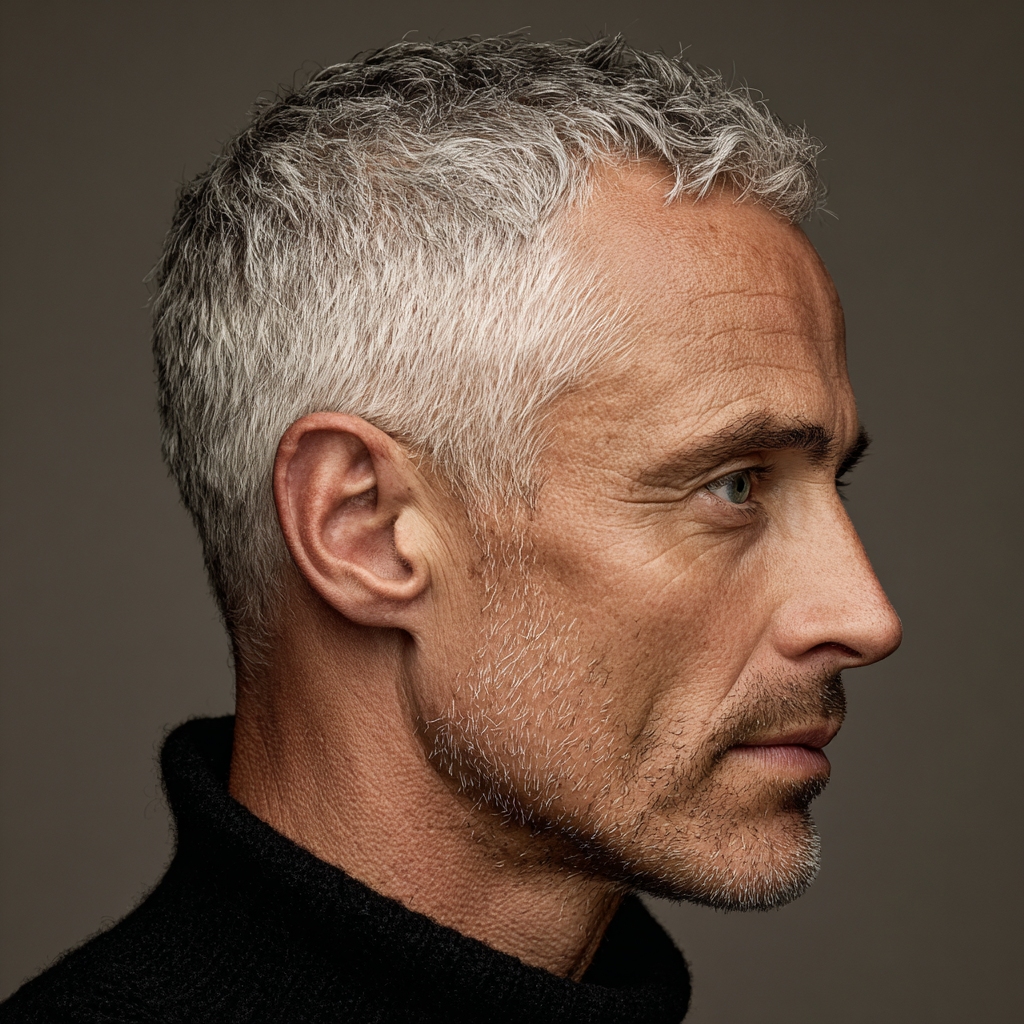
Keep the Sides Short
Long sides with a thinning top create the most unflattering contrast possible. The sides look full, the top looks thin, and the eye goes immediately to the difference. Shorter, tapered sides bring the overall density into proportion with whatever is happening on top.
Gray Hair Is Not the Enemy
In fact, gray hair often helps thinning hair look better. Dark hair against a light scalp creates exactly the contrast that makes thinning obvious.
Gray, particularly silver and salt-and-pepper, reduces that contrast significantly. The scalp and the hair are closer in tone, and thinning reads as texture rather than loss.
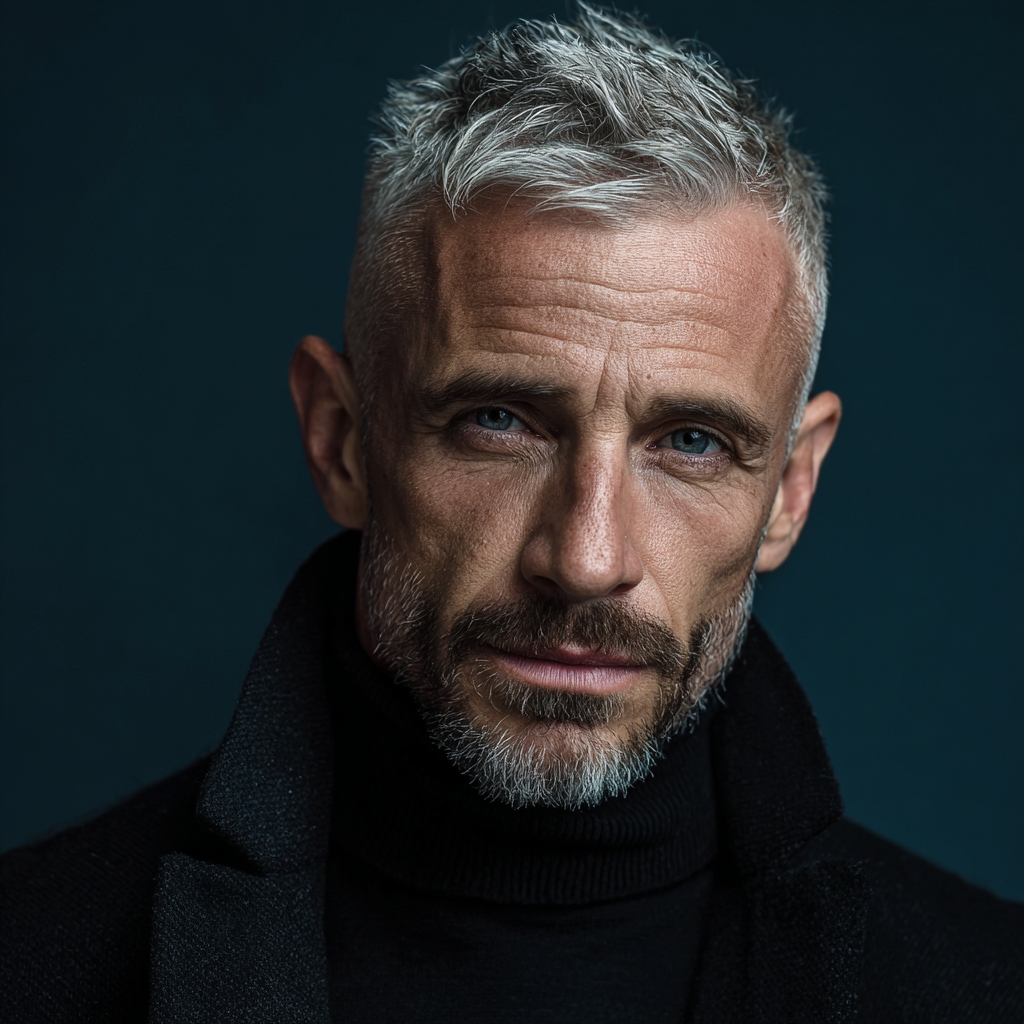
If you are graying:
- Avoid overly dark dyes — they fight the contrast battle and lose
- Embrace salt-and-pepper tones — this is a visual asset, not a problem
- Let texture do the work — gray hair with movement reads as experience and intention
Gray hair with a smart cut reads as experience, not decline.
Hair Transplants for Men Over 50: An Honest Assessment
Hair transplants are a legitimate option. Many men over 50 pursue them successfully. But this topic deserves honesty rather than the brochure version, because the conversation about whether it makes sense for you is more complicated after 50 than it was at 35.
What Changes After 50
Donor hair quality matters more. A transplant moves hair from a donor area, typically the back and sides of the scalp, to the thinning area. After 50, donor hair is often finer, less dense, and the available supply may be more limited than it was a decade earlier. A skilled surgeon will assess this candidly. A less scrupulous one may not.
Native hair continues to thin. A transplant puts hair where you want it, but does not stop the progression of loss in the surrounding area. Men who get transplants at 52 and do not address underlying thinning often find that in five years, the transplanted area looks like an island. Ongoing treatment is usually recommended alongside any procedure.
Expectations need calibration. A transplant restores coverage, not density. What it can do is create a natural-looking hairline at a lower, more receded position, with enough coverage that a short haircut looks intentional rather than sparse.
The Two Main Methods
FUE (Follicular Unit Extraction) is the current standard. Individual follicles are removed from the donor area one by one and transplanted to the recipient area. There is no linear scar. Recovery is faster. If you wear your hair short — as most men over 50 with receding hairlines do — FUE is almost always the better option.
FUT (Follicular Unit Transplantation / Strip Method) removes a strip of scalp from the donor area and extracts follicles from it. It leaves a linear scar across the back of the head. It was the dominant method for decades and still has applications, but the scar is a significant drawback for men wearing short styles.
What a Good Result Looks Like — and What to Avoid
A successful transplant for a man over 50 is not a restored 25-year-old hairline. It is a natural, age-appropriate hairline that sits at a position consistent with your current face and bone structure, filled with enough density to hold a short haircut confidently.
Warning signs in a consultation: a surgeon who promises thick coverage, who designs a hairline too low for your age, or who does not ask about your pattern of ongoing loss. These are flags.
Good questions to ask a clinic: What is my donor density? Where do you recommend placing the hairline given my age and likely future loss? What ongoing treatment do you recommend alongside the procedure? Can I see results on patients with a similar type and hair texture to mine?
A transplant is not a reset button. It is a refinement tool. Even men who get excellent transplants still need a good haircut to make the result look natural.
If you are curious, speak to a reputable clinic about hair loss treatment options. If you are not ready, you are not behind. You are simply choosing a different path.
The Confidence Shift That Changes Everything
Here is the truth most men discover too late:
People notice insecurity far faster than they notice a receding hairline.
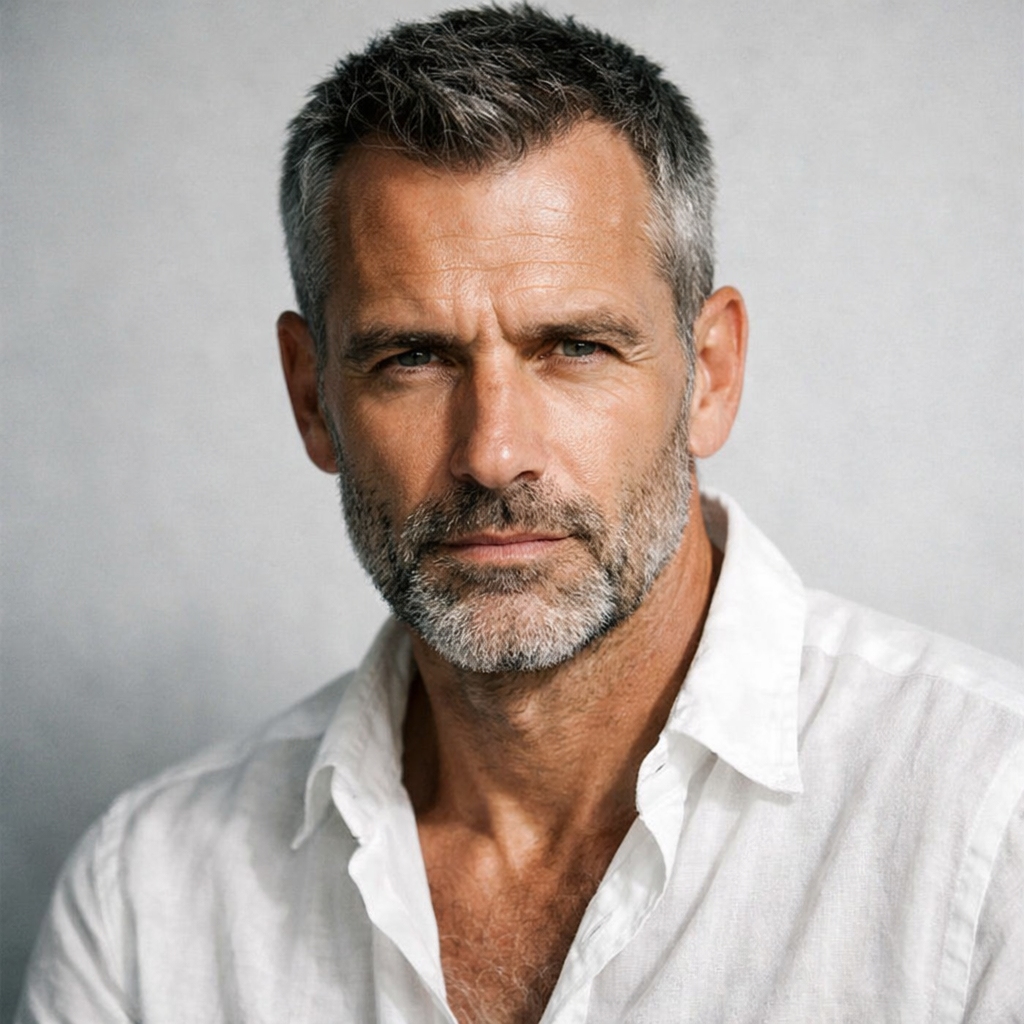
Men over 50 who look good are not chasing youth. They are choosing clarity, proper sense of style, and proportion.
A great haircut at this stage of life does not say:
“I still have hair.”
It says:
“I know exactly who I am.”
Final Thoughts
A receding hairline after 50 is normal. Thinning hair is common. Neither disqualifies you from looking sharp, attractive, or confident.
You can explore hair implants. You can keep it short. You can shave it clean. All of these are valid choices when made with intention rather than panic.
The best haircut is the one that:
- Works with your hair, not against it
- Requires minimal daily stress
- Makes you feel calm when you look in the mirror
That is not settling.
That is mastery.
Explore More:
Top Hairstyles for Gray Hair Men Over 50 | New Looks: A practical guide to modern hairstyles that work with gray hair, helping men over 50 look current, confident, and well-groomed without chasing trends.
Silver Fox Hair for Men: Style & Grooming Tips: From haircut choices to grooming details, this guide shows how to refine the silver fox look with intention and effortless confidence.
Haircuts for Senior Men: Looking Sharp & Sophisticated Over 60: A curated selection of haircuts designed for men over 60 who want a clean, sophisticated look that reflects experience rather than age.
Salt and Pepper Hair and Beard for Men: Embrace Personal Style: An editorial take on pairing salt-and-pepper hair with a beard, focusing on balance, grooming, and a strong personal style at any age.
Effortless Wash-and-Wear Haircuts for Men
Low Taper vs Mid Taper: Key Differences Explained
Men’s Long Curly Haircuts and How to Elevate Your Look
Drop Fade Haircut: Styles, Variations for Different Hair Texture and Modern Inspiration
20 Slick Back Hairstyles for Men: Classic, Textured, and Modern Cuts