The Men Who Look Better at 55 Than They Did at 35 All Did One Thing
I spent almost twenty years inside fashion and advertising before I noticed the pattern. Not in a magazine. In a gym locker room. Same gym. Same week. Two men, twenty years apart in age.
The 55-year-old looked better.
Not better for his age. Not “he’s aging well.” Better. Period. If the assignment was “who looks like he has his life together,” you’d pick him first, no hesitation.
People like to say men age like wine. Most do not. Wine improves because it is stored properly, left alone, and not interfered with every six months. Men improve for roughly the same reason: they learn what works, stop panicking, and become more selective about what they add.
So what had the older man figured out that the younger one hadn’t?
What It’s Not
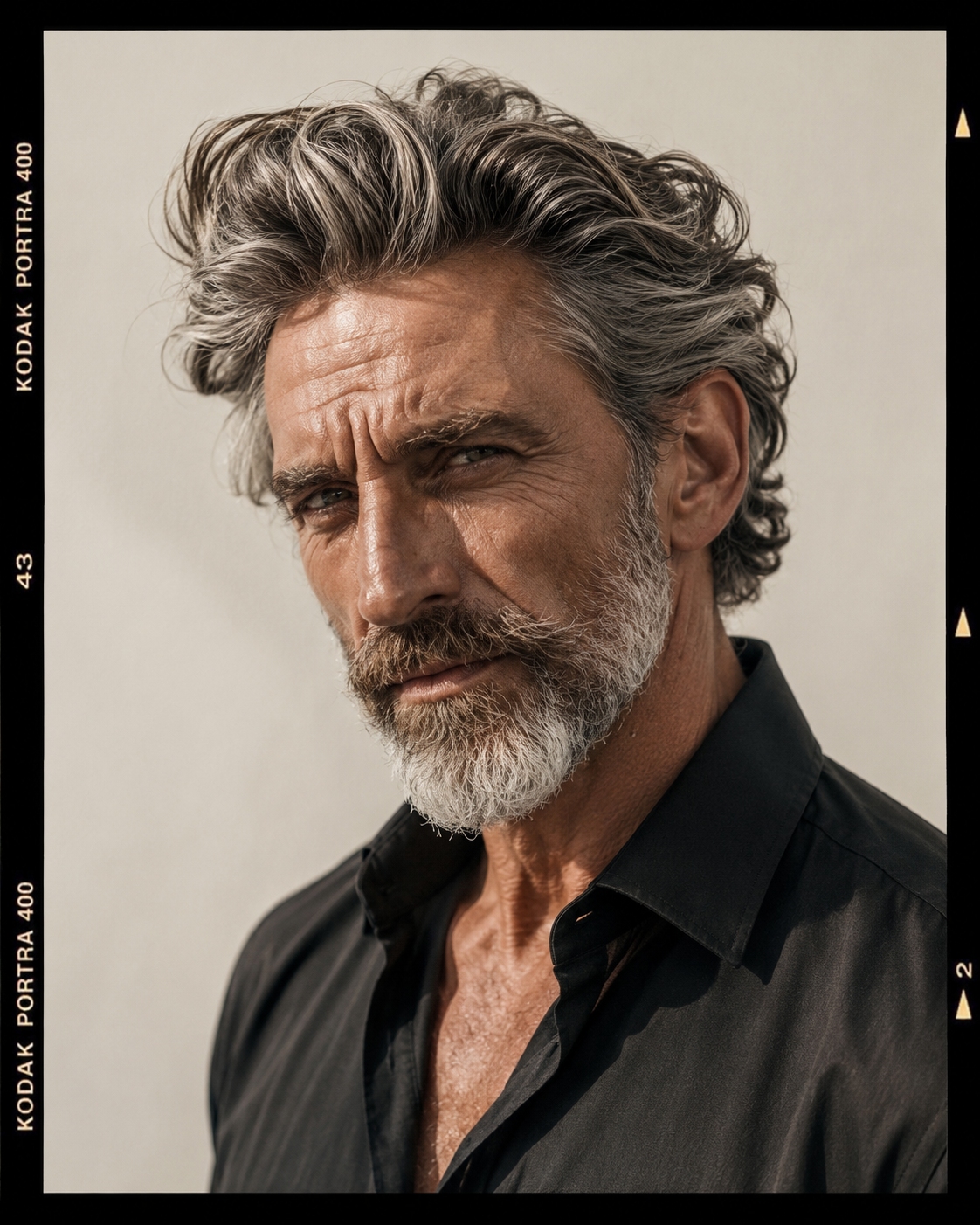
Not genetics. Good features can help, but they do not automatically create presence, taste, or coherence. I have dressed plenty of conventionally handsome men whose clothes, haircut, and grooming still worked against them.
Not money. A large wardrobe is not the same thing as a considered one. You can spend five figures and still look as though every piece was chosen by a different version of you.
Not a trainer. Fitness can improve posture, movement, and the way clothes sit, but it cannot resolve the whole picture. The body is one element. It was never the entire answer.
Not a transformation. No dramatic before and after. The man who seems to be reaching his prime at 55 did not stop evolving. He stopped changing for the sake of change.
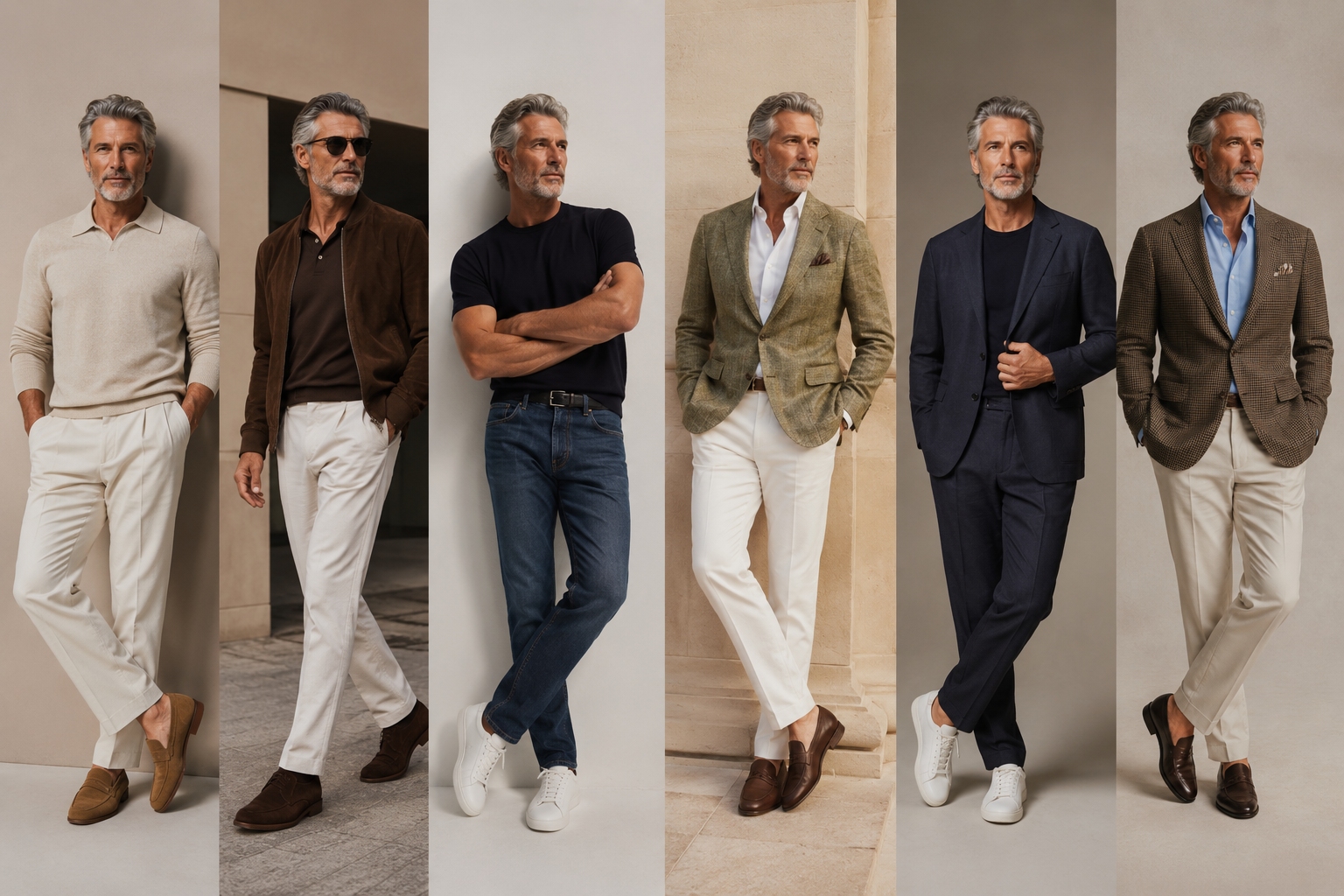
This is what a finished wardrobe looks like in practice. The outfits move from knitwear and denim to tailoring, but the palette and proportions barely change. That is the system.
The Uniform
This is not an argument against trying something new. It is about building the wardrobe around what already works, buying selectively, and leaving room for a new cut, color, or idea when it genuinely feels like yours.
At 35, men are still figuring it out. New haircut every couple of years. Wardrobe reset every season because something new came out. A grooming routine borrowed from whatever was trending that month.
That’s normal at 35. You’re still collecting data on what works.
By 45, most men have the data. A haircut that suited his face, and he kept it. A handful of fits that worked on his build, and he repeated them. A grooming routine with maybe four products, the same four, for a decade.
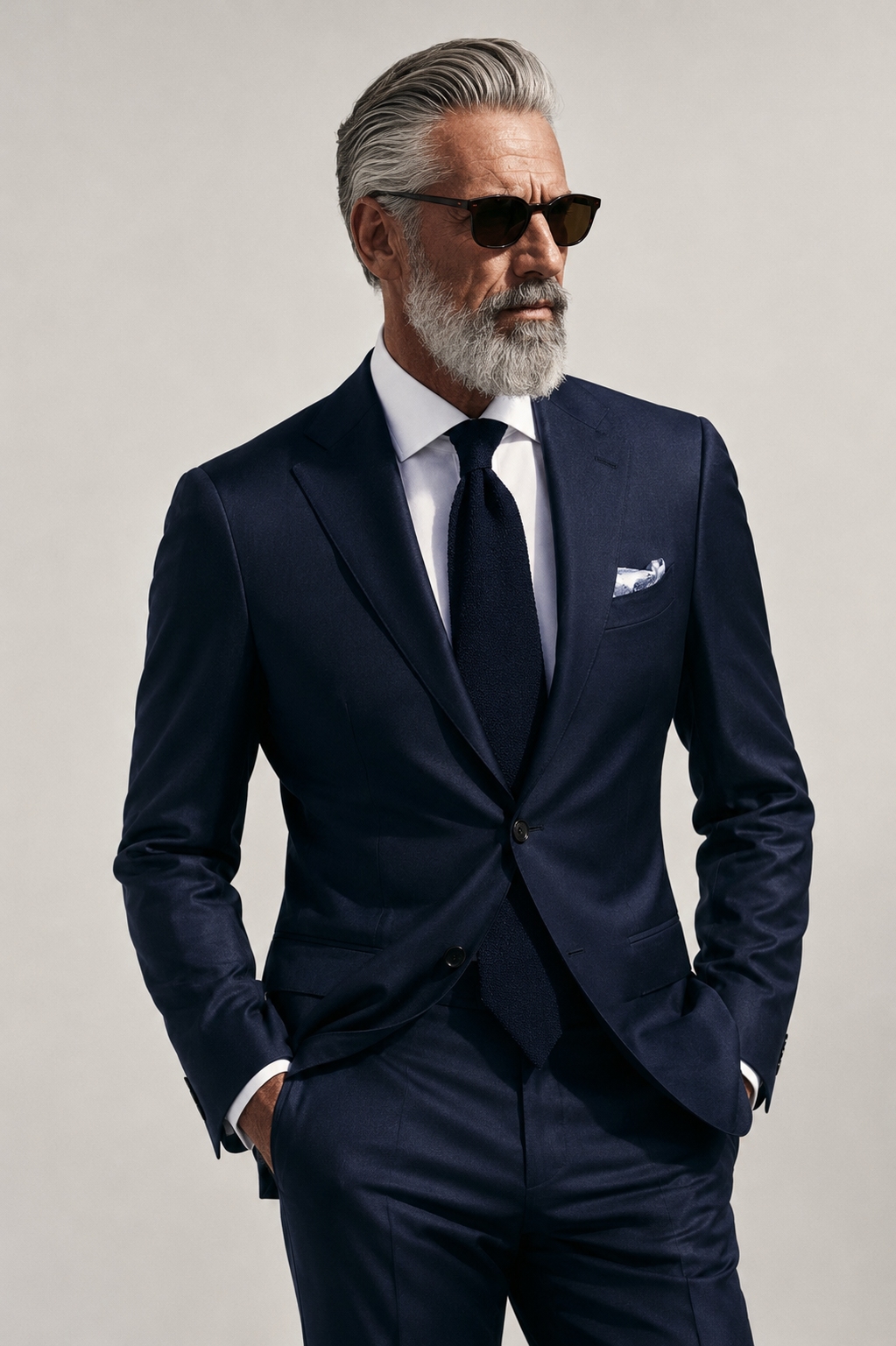
He stopped optimizing for new. He started optimizing for right.
This is the thing nobody tells you, and it’s the thing I had to unlearn after years of being paid to chase what’s next. Looking good past 50 isn’t about fighting time harder. It’s about converting twenty years of trial and error into a system and sticking to it.
Less variance. More precision.
The man still chasing what’s new at 50 is making the same mistake he made at 30. He just has worse odds now.
The Confidence Is in the Repetition
Repetition looks different after 50.
On a younger man, wearing the same thing too often can look like he hasn’t figured out what else to do. On an older man, when the choices are right, repetition reads as control.
The same navy jacket. The same clean knit. There is no panic in it.
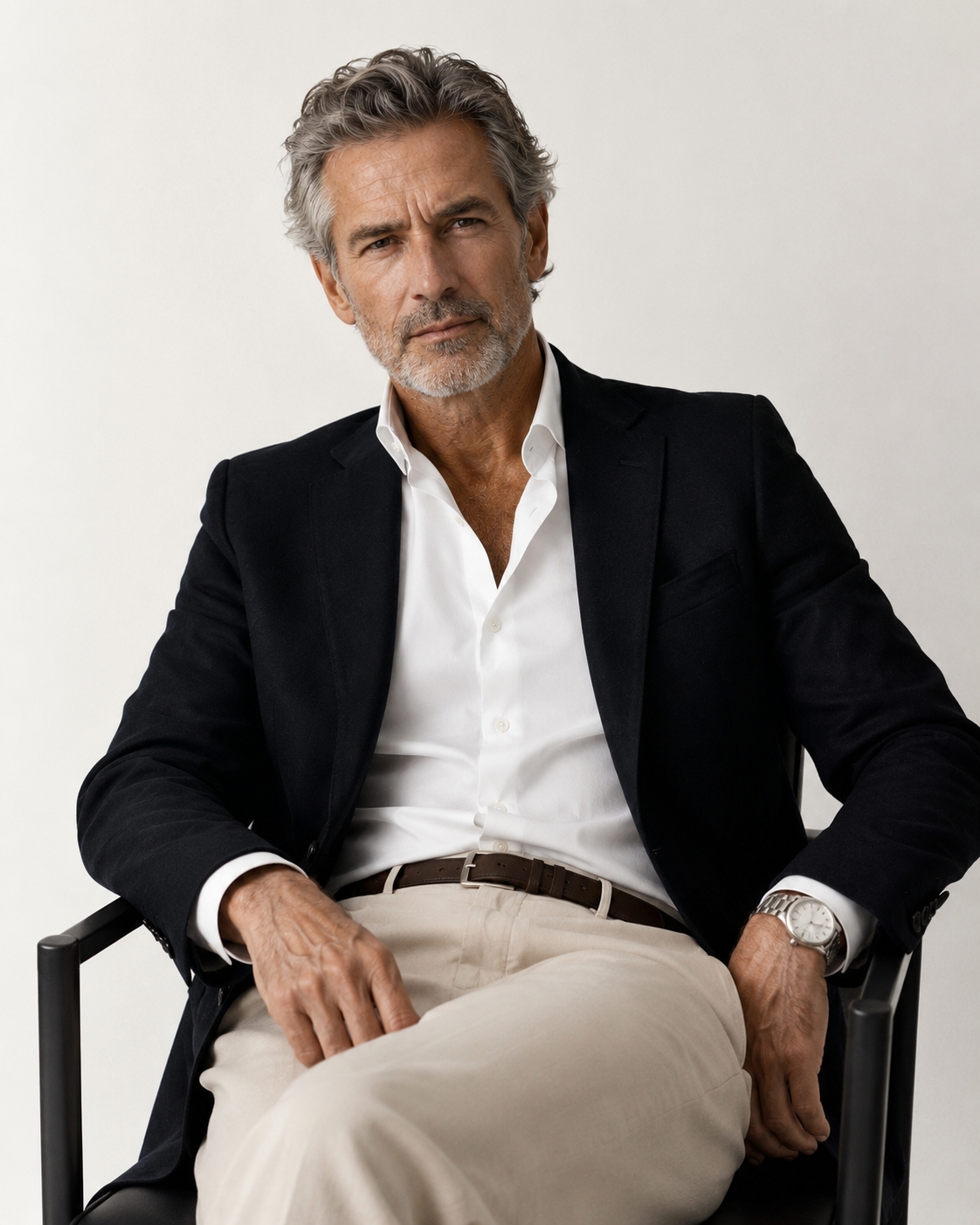
That is the difference. A man who knows what works does not need every outfit to announce a new version of himself. He is not dressing for surprise anymore. He is dressing for recognition.
You think style is variety. I used to think that too, professionally, for longer than I’d like to admit. At a certain age, style is consistency with small adjustments.
The man who looks better at 55 has not frozen himself in time. That would look sad. He has kept the parts that work and quietly removed the parts that no longer do.
Nothing dramatic happened, which is exactly why it worked.
What Men’s Style After 50 Actually Looks Like
This isn’t theoretical. Walk into it.
One haircut. Not a style he’s loyal to out of nostalgia. A cut that works with his hairline, his face shape, his texture, refined over a decade until the barber doesn’t need instructions anymore.
A color story for clothes that doesn’t change. Navy, charcoal, white, maybe one accent he trusts. Not because he’s boring. Because he learned which colors work against his skin.
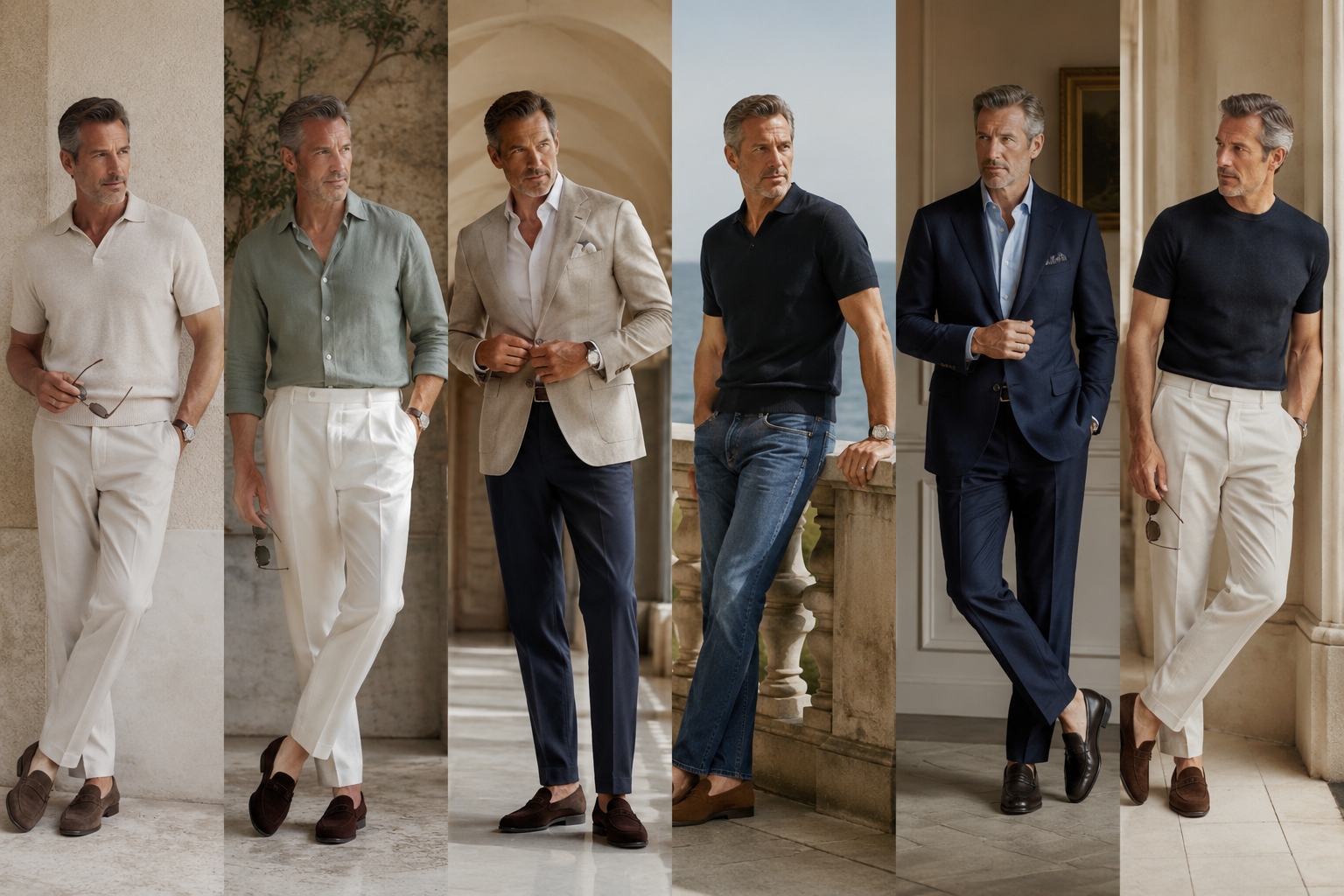
Fit over trend, every time. The jacket is cut close because he knows close works on him, not simply because close is in this season. He may still notice what is new. He just no longer lets “what’s in” make the decision for him.
The Closet That Does the Work
The man who looks better at 55 usually does not have a huge wardrobe. He has a narrower one. Better chosen, better repeated, less apologetic.
His closet tends to be built around pieces like these:
- A navy or charcoal jacket that works over almost everything.
- Dark straight-leg jeans that do not fight his body.
- A white or pale blue Oxford shirt.
- A clean knit polo or merino crewneck.
- Grey, navy, or olive trousers with some shape.
- Loafers, suede derbies, or minimal leather sneakers.
- A coat or jacket with enough structure to make the rest of the outfit look intentional.
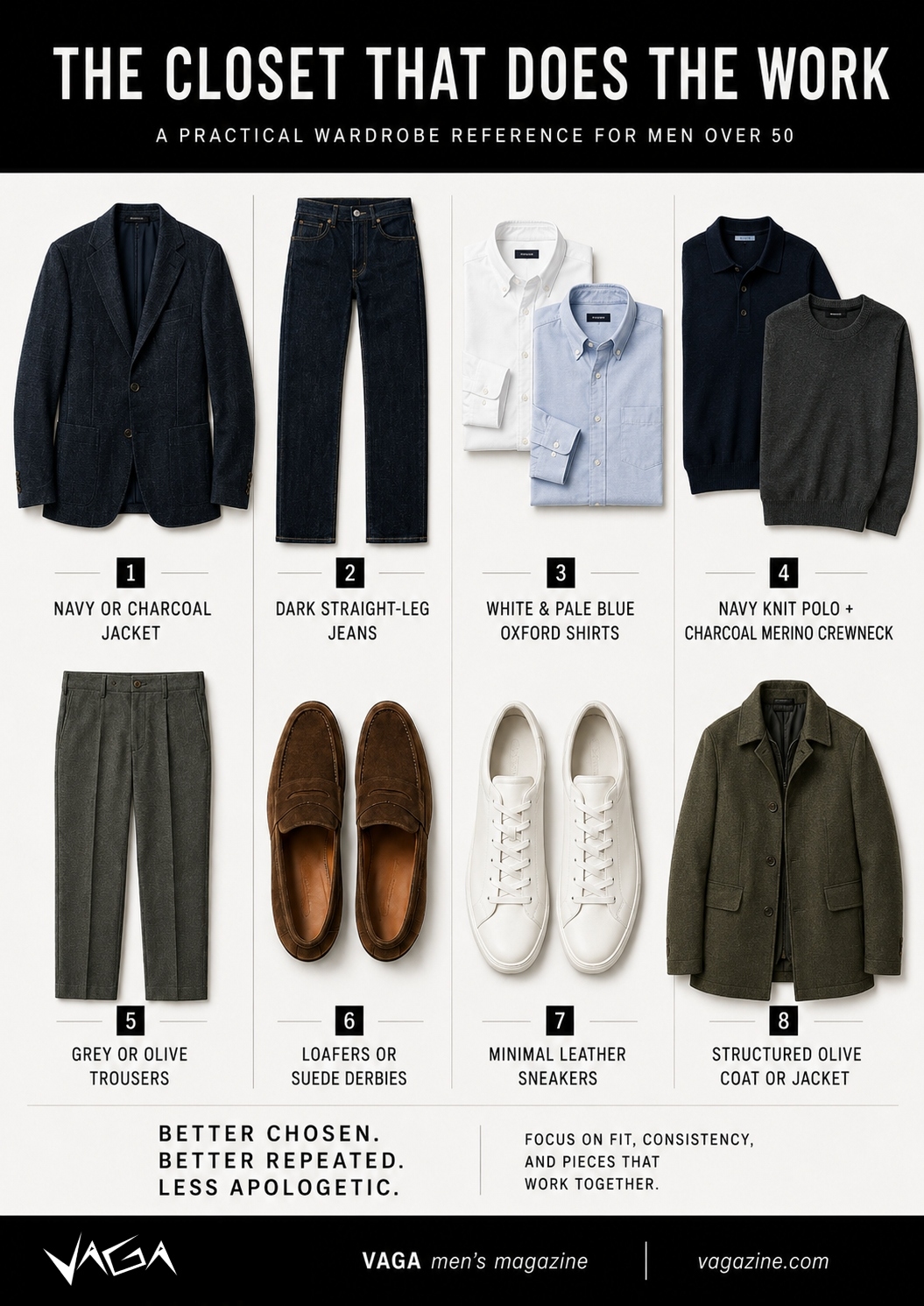
A useful wardrobe after 50 is narrow on purpose: one dependable dark jacket, straight jeans, pale shirts, clean knits, shaped trousers, and two or three pairs of shoes that work across the whole closet.
None of these pieces are revolutionary. That is why they work. That is the difference between having clothes and having a uniform.
10 Outfit Formulas to Repeat After 50
These are 10 outfit formulas built from one controlled wardrobe: navy, camel, olive, grey, cream, and denim. The pieces repeat. Only the level of structure changes.
Use them as templates, not shopping lists. Get the proportions right first: some definition through the shoulder, a clean line through the trouser, and shoes that do not fight the rest of the outfit.
For a broader occasion-by-occasion reference, see our guide to outfits for men over 50.
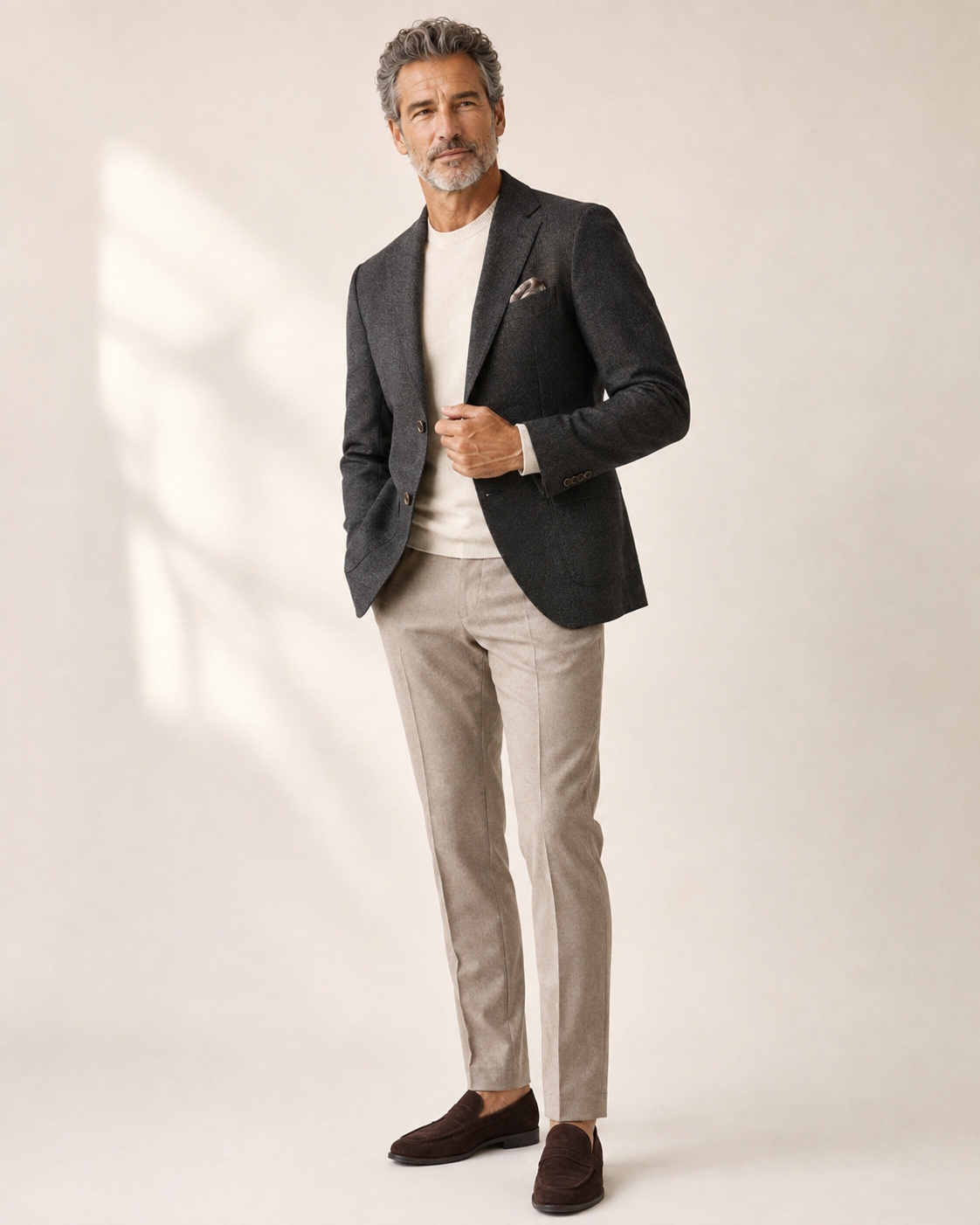
1. The Charcoal Blazer and Cream Knit
Start with a charcoal blazer, an ivory or oatmeal crewneck, taupe straight-leg trousers, and dark-brown loafers. The light knit softens the face while the jacket gives shape through the shoulders. It works for dinner, the office, travel, or any room where a suit would feel like too much.
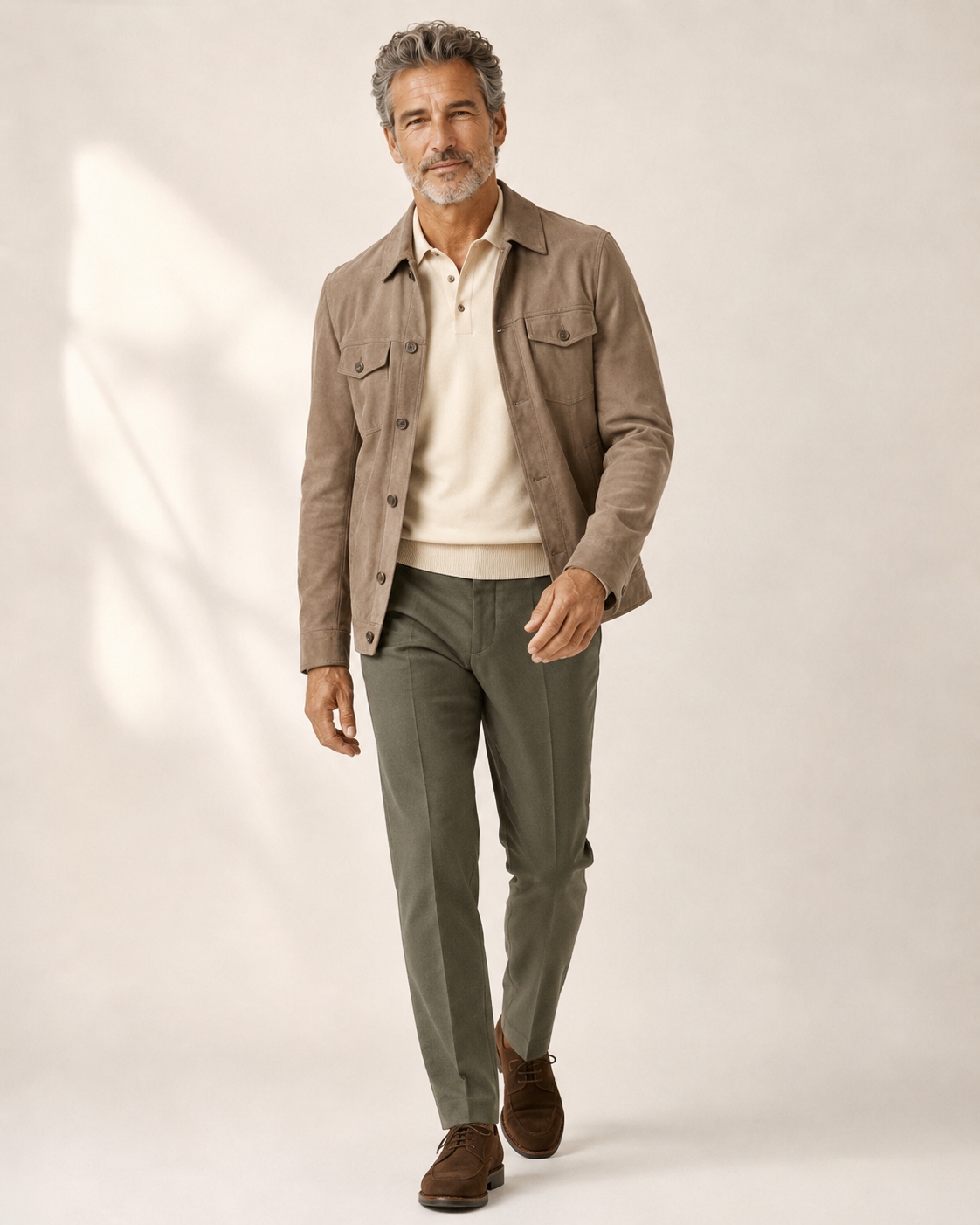
2. The Suede Jacket and Olive Trouser
Use a taupe suede or brushed-cotton overshirt over a cream knit polo, then add olive trousers and brown suede shoes. Texture makes the outfit feel richer without adding more color. Keep the jacket trim but not fitted like a blazer, and let the trousers skim the leg instead of gripping it.
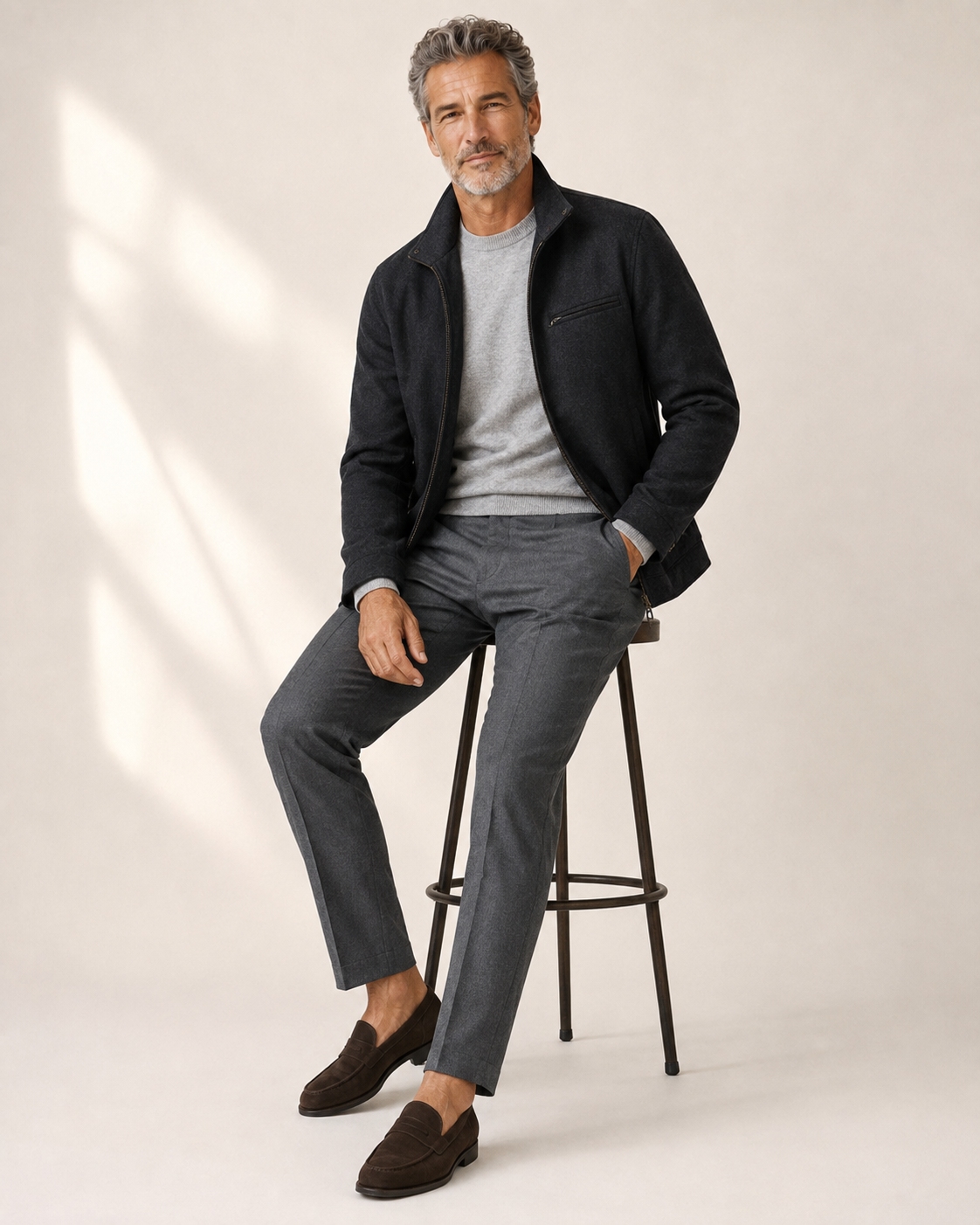
3. The Tonal Grey Uniform
Combine a dark charcoal jacket, a light-grey knit, mid-grey trousers, and brown loafers. The grays need to be visibly different in depth and texture; otherwise the outfit turns into one large administrative document. Brown shoes warm it up and keep it from feeling too corporate.
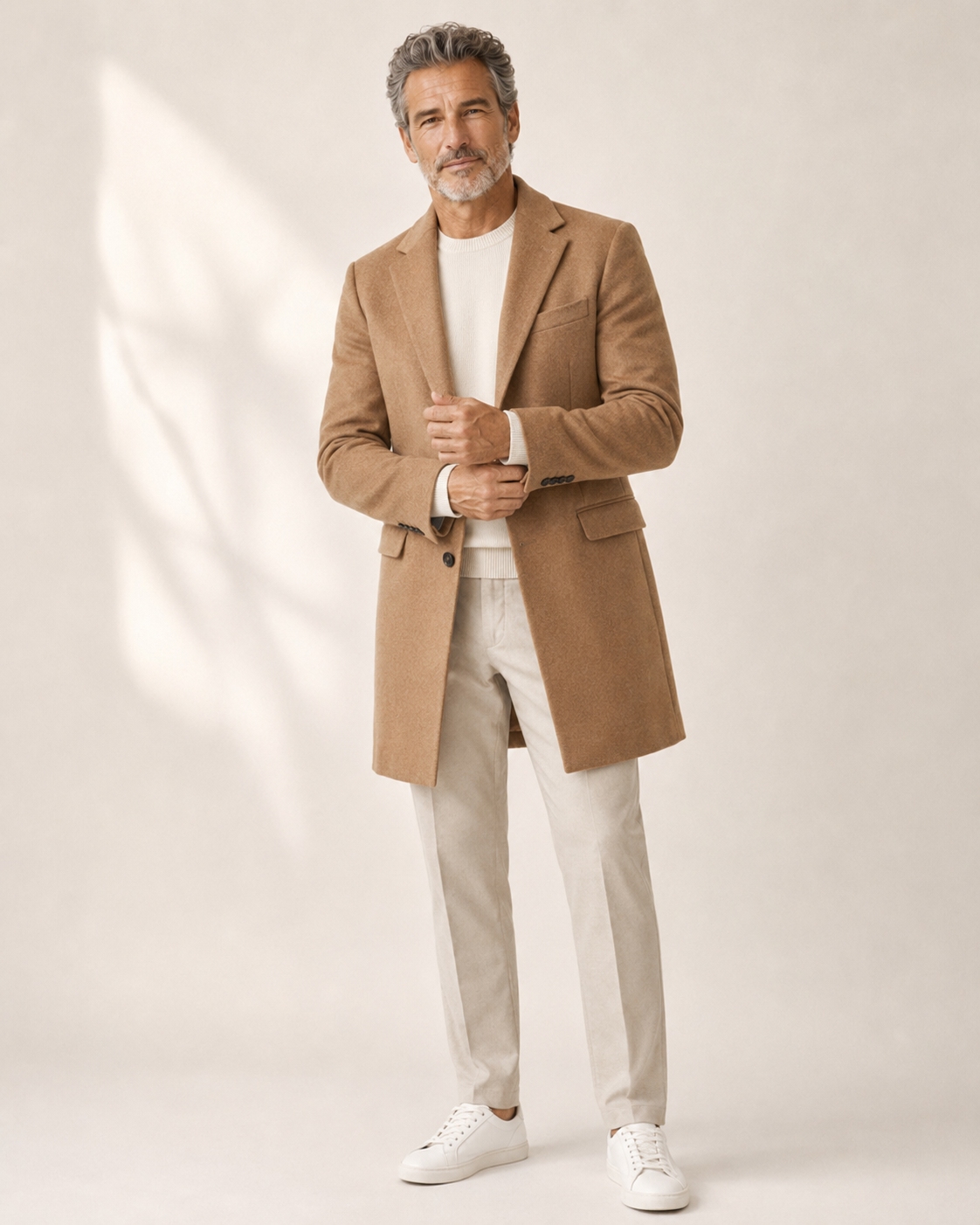
4. The Light Camel Coat
Layer a camel coat over a cream crewneck and stone trousers. Minimal white leather sneakers keep the traditional coat from feeling overly formal. A straight trouser with little or no break matters here; excess fabric around the ankle ruins the clean vertical line.
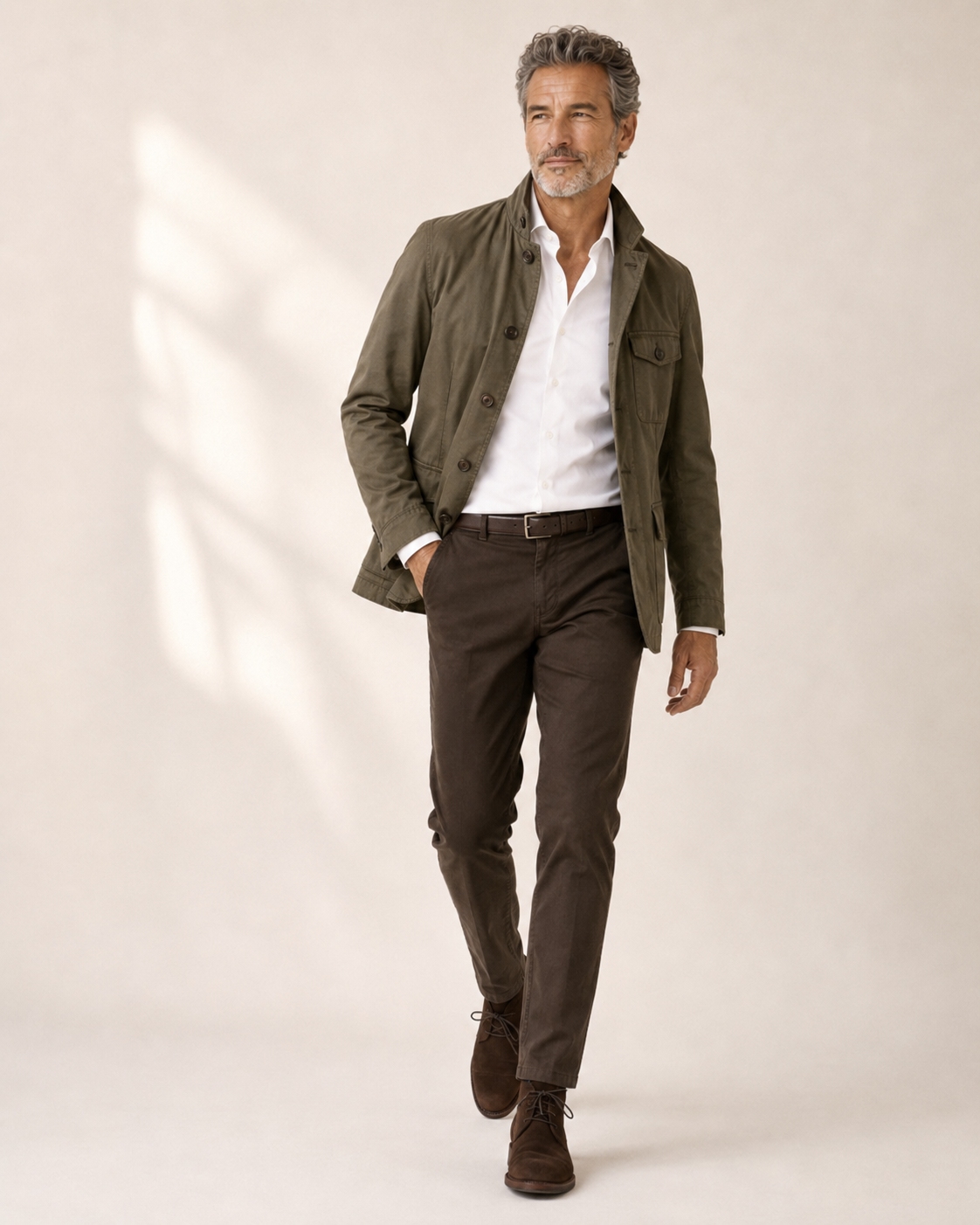
5. The Field Jacket and White Shirt
An olive field jacket can replace a blazer when the rest of the outfit is cleaner than the jacket is rugged. Wear it over a crisp white shirt with dark-brown trousers and suede shoes. Avoid cargo trousers here. One utilitarian piece is a choice; three of them is field research.
6. The Navy Polo and Tan Blazer
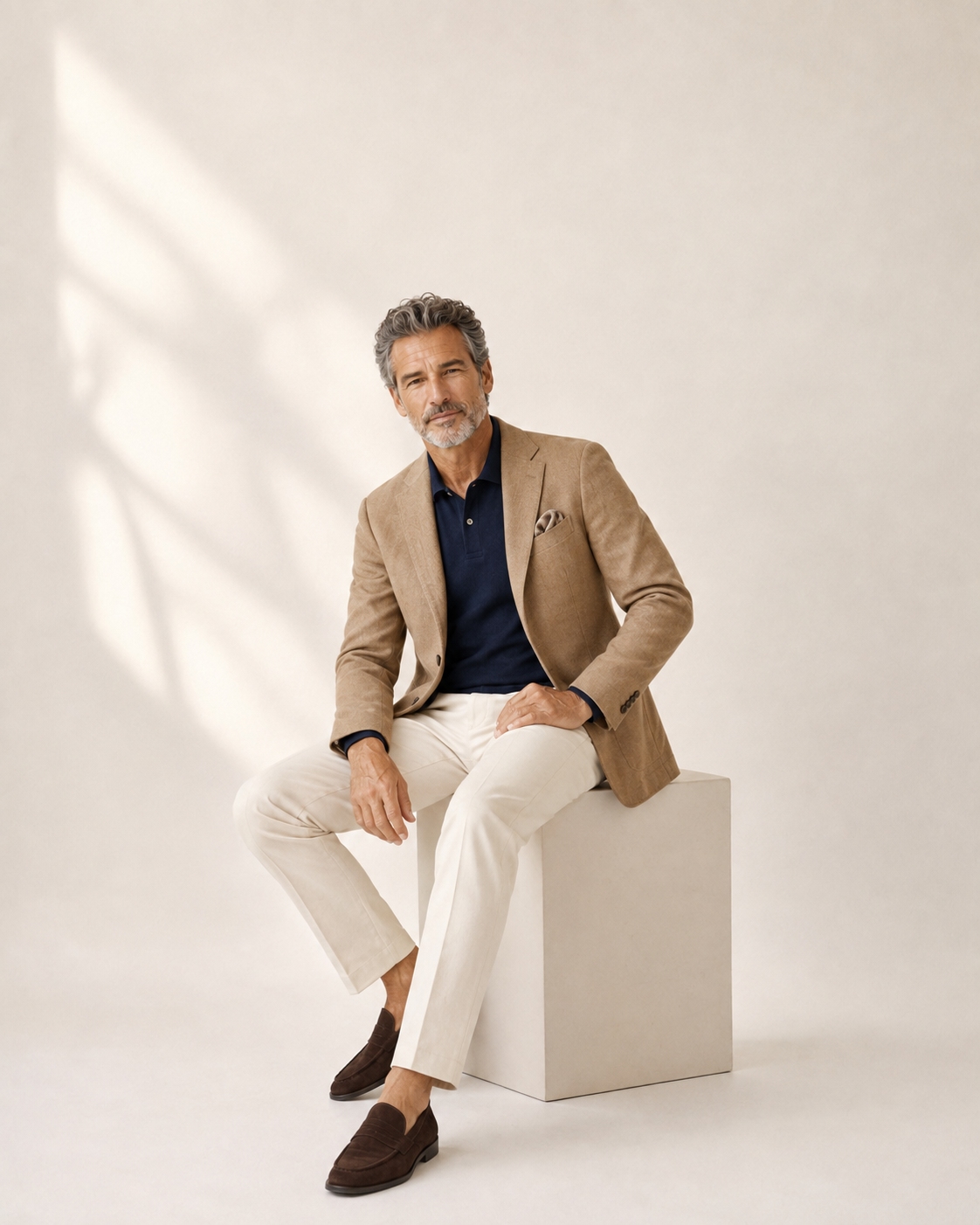
A tan blazer, navy knit polo, cream trousers, and dark-brown loafers create the quieter version of what the internet calls old-money style. The knit collar gives more polish than a T-shirt and less formality than an Oxford. It is especially useful for spring dinners, travel, and daytime events.
7. The City Coat and White Sneaker
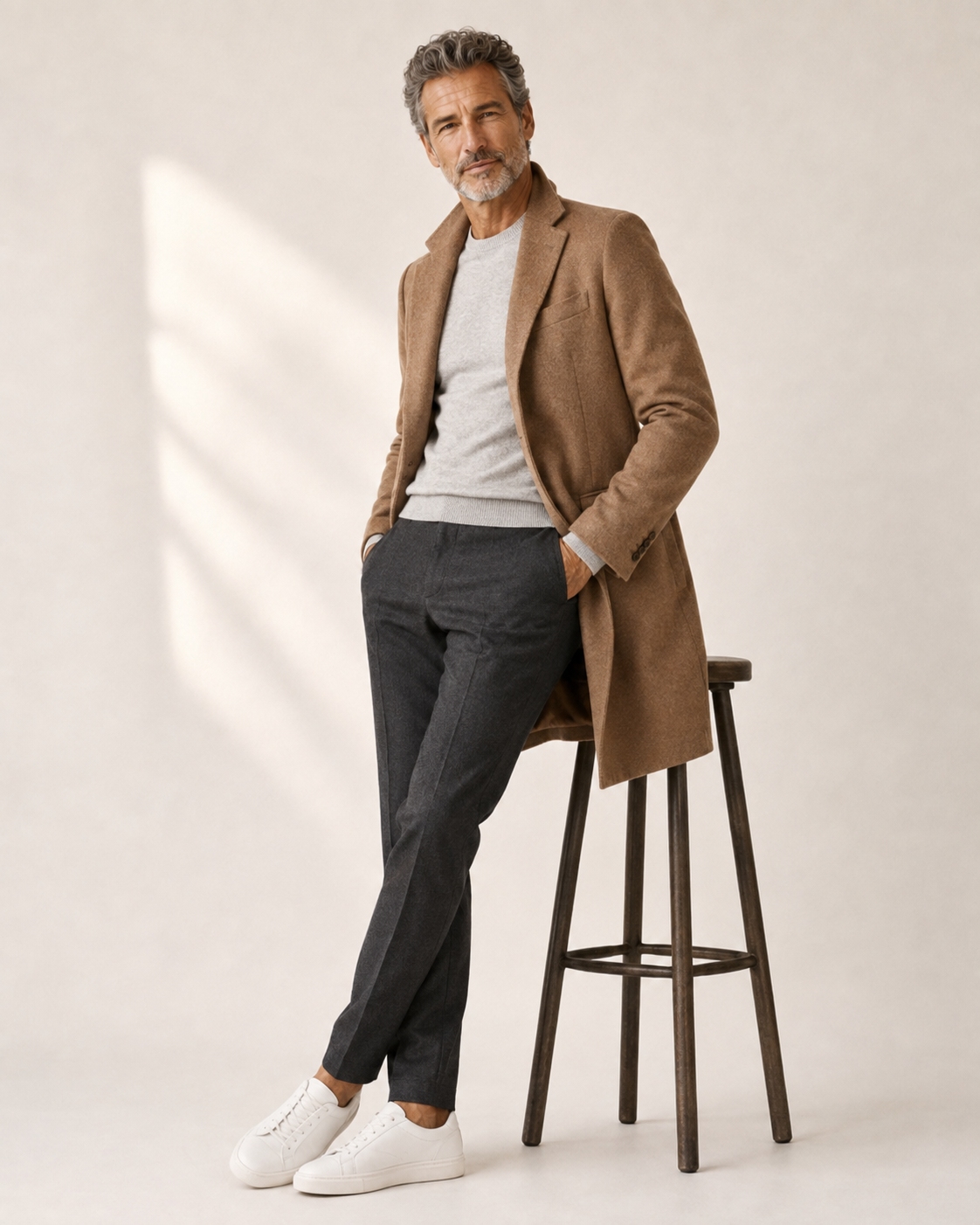
The long camel coat carries this outfit. Under it, a light-grey knit and charcoal trousers stay almost anonymous, which is exactly their job. Choose a coat ending around the knee and a low-profile leather sneaker with minimal branding. Modern comes from the clean line.
8. The Bomber Without the Youth Costume
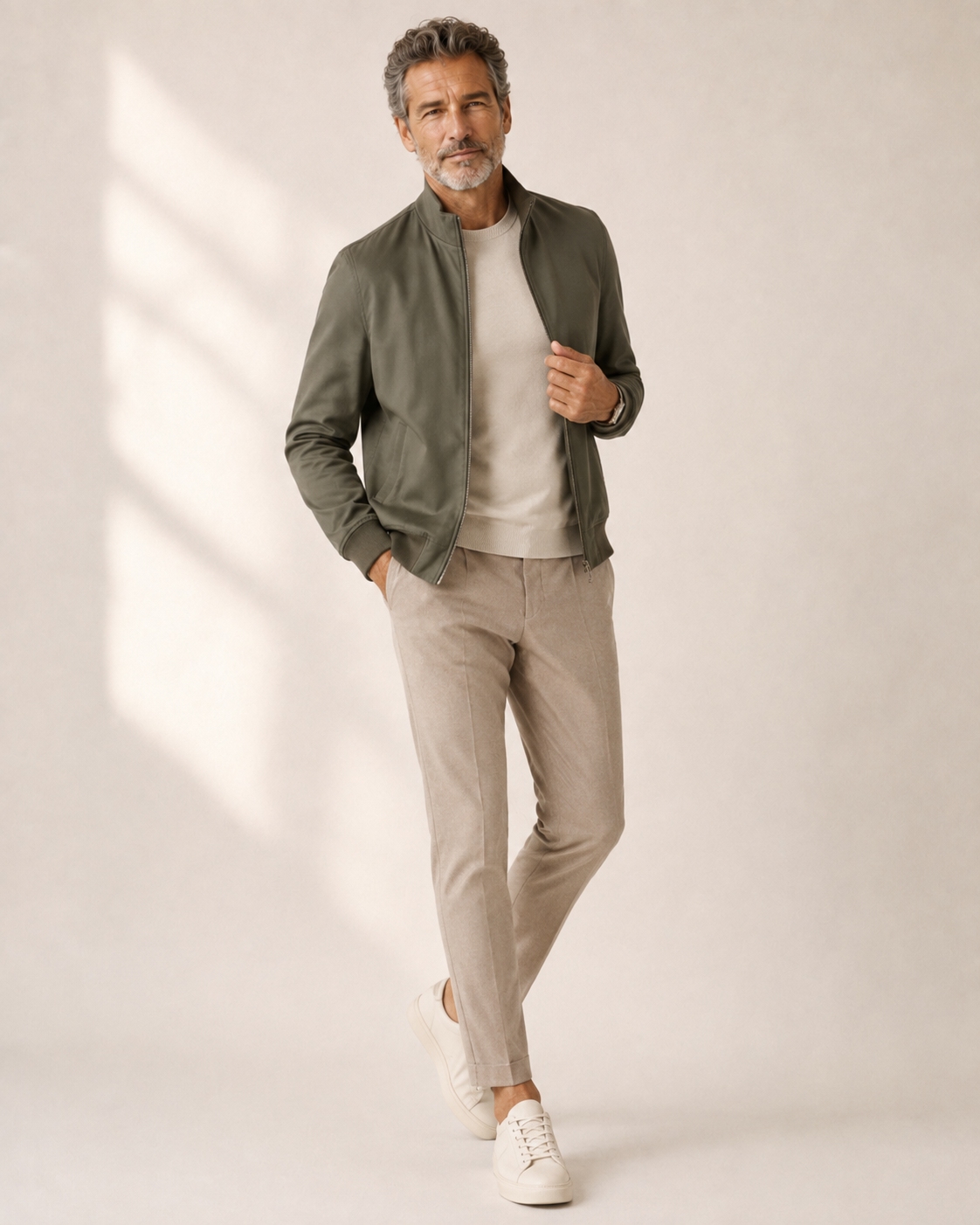
A bomber jacket works after 50 when it is matte, minimally detailed, and worn with trousers instead of joggers. Add a fine-gauge stone knit, taupe trousers, and simple leather sneakers. Avoid shiny nylon, bulky ribbing, and oversized proportions.
9. The Navy Shirt and Straight-Leg Jeans
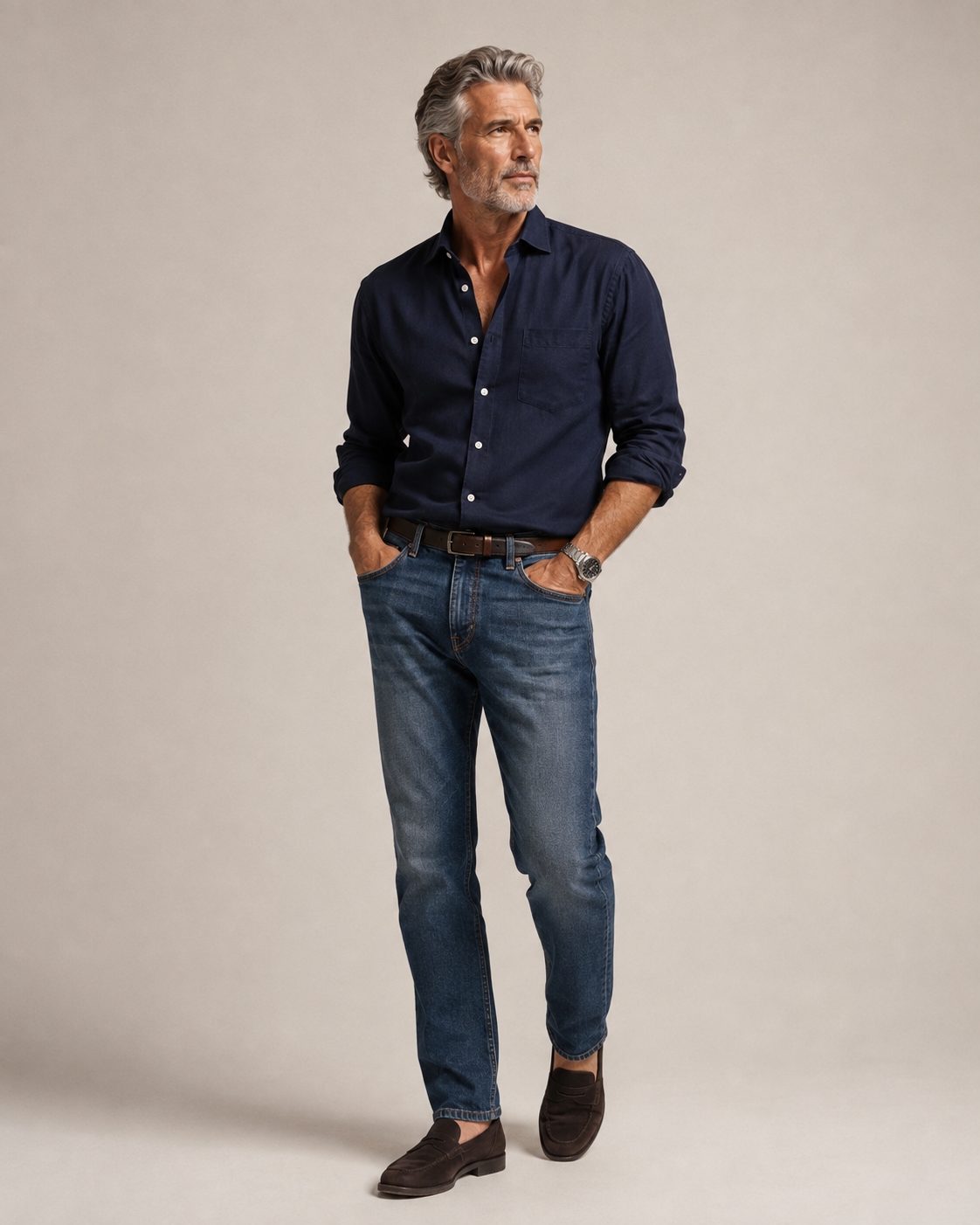
A well-fitting navy shirt gives the upper body some definition, while medium-to-dark straight-leg jeans keep the look relaxed without becoming shapeless.
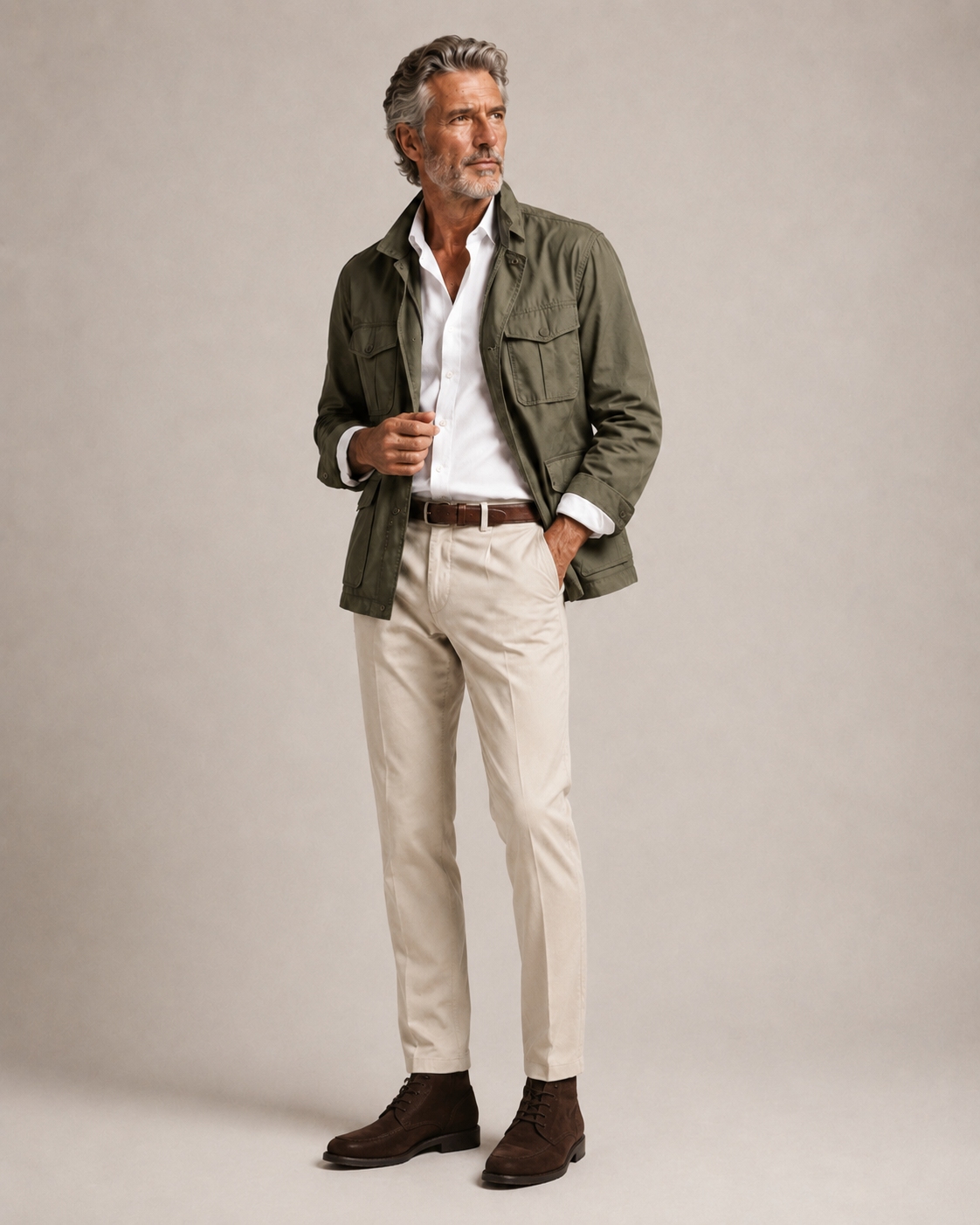
10. The Olive Field Jacket and Cream Trousers
The olive field jacket adds structure and a slightly rugged edge, while the white shirt and cream trousers keep the outfit light, polished, and easy to wear. The jacket should finish around the hip and have enough room to sit comfortably over the shirt. Keep the trousers straight or gently tapered, then repeat the brown of the belt in a pair of dark suede chukka boots. The boots add weight and texture, making the outfit work especially well through autumn and winter.
The Body Still Matters, Just Not Alone
The body matters, obviously. Clothes sit differently on a man who moves well, has some energy, and still carries himself with intention.
But this is not really about becoming the biggest, leanest, or most disciplined man in the room. It is about applying the same editing instinct to the body that he applies to the wardrobe.
He becomes more selective. Not necessarily with how much he eats, but with what he eats most often. Less noise, fewer habits that never give much back.
The same goes for movement. It does not have to be dramatic. Walking, lifting something regularly, staying mobile, sleeping properly.
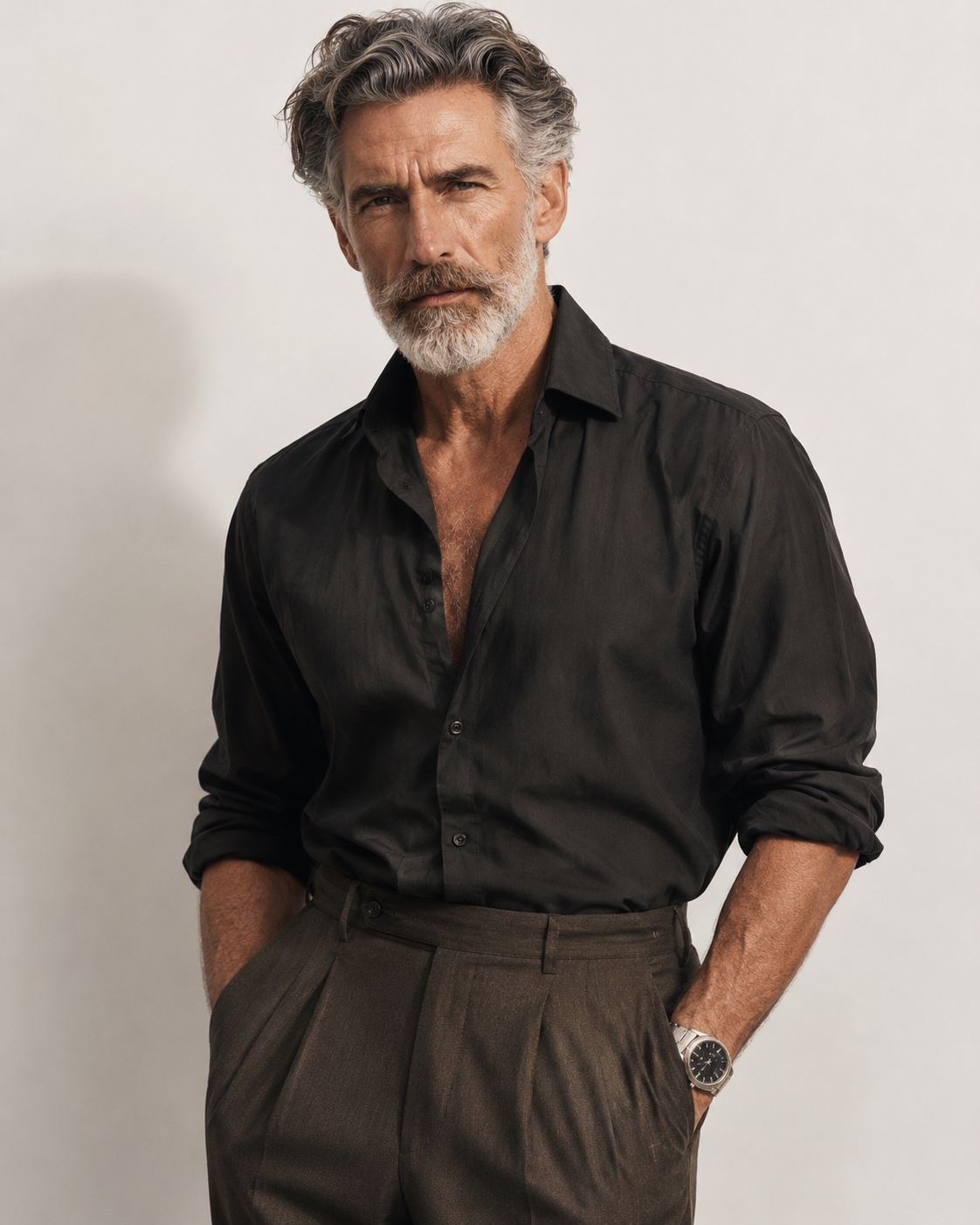
The sharper older man understands proportion. He knows where he needs structure and where he needs softness.
He knows whether his face looks better with a little stubble or a clean shave. He knows whether his hair needs height, texture, or less ambition.
That knowledge is not glamour. It is maintenance with taste.
The Tell
You can spot the man who hasn’t built his system yet before he says a word.
He’s got a new haircut every time you see him. Not because his style is evolving. Because he’s still hoping the next one is the one that finally works. His closet has things in it he’s never going to wear again but won’t get rid of.
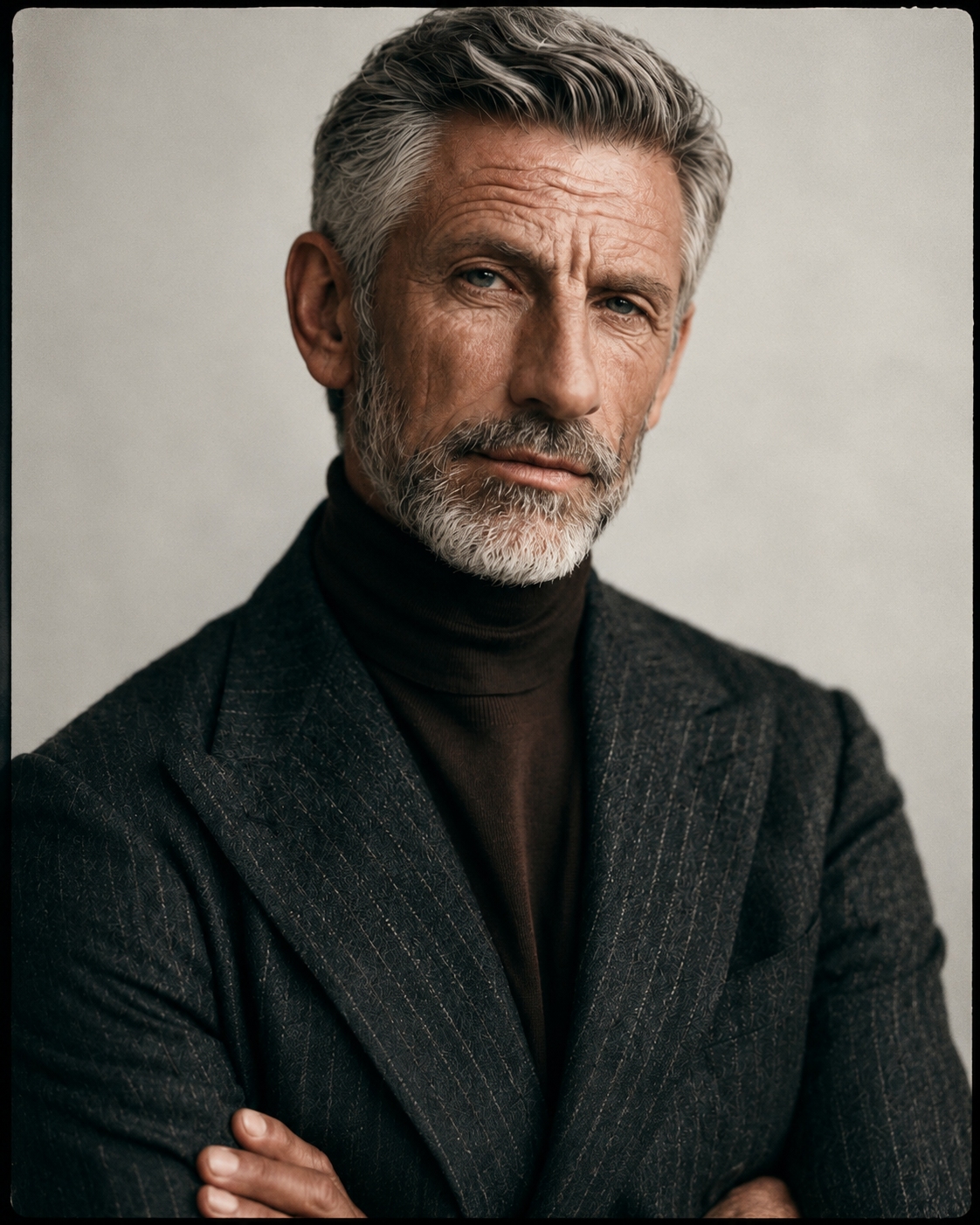
None of this makes him a bad dresser. It makes him a man still treating every decision like a fresh experiment, even though he already has years of evidence about what works.
Why 35 Can’t Do This Yet
This isn’t a knock on younger men.
At 35, you genuinely don’t know yet. You haven’t worn enough cuts, tried enough fits, made enough mistakes to know what actually works on your face, your build, your life.
Experimentation at 35 is correct. It’s the job. The mistake is doing the job forever. Treating every year like it’s still discovery phase when you already have the answer sitting in your closet, on your head, in your bathroom cabinet.
At some point, the experiment ends.
You take the data. You build the system. You stop trying you keep improving.
The Audit
The system starts with subtraction.
- What haircut has made you look most like yourself, not most like someone else?
- What colors make your face look alive instead of tired?
- Which clothes do you reach for when you need to feel composed?
- Which pieces make getting dressed easier every single time?
- Which pieces in your closet are only there because you once bought the idea of a different life?
- Which grooming products do you actually finish?
- Which ones are just evidence of optimism with a receipt?
A man does not need a complete reinvention at 50. Most of the time, he needs to stop betraying the evidence.
The best version is usually already there, scattered across the last twenty years. One good haircut from years ago. One jacket that always worked. One pair of trousers that made everything easier. One grooming habit that actually improved his face.
The work is not to become someone new.
The work is to notice what kept working and finally take it seriously.
The One Thing
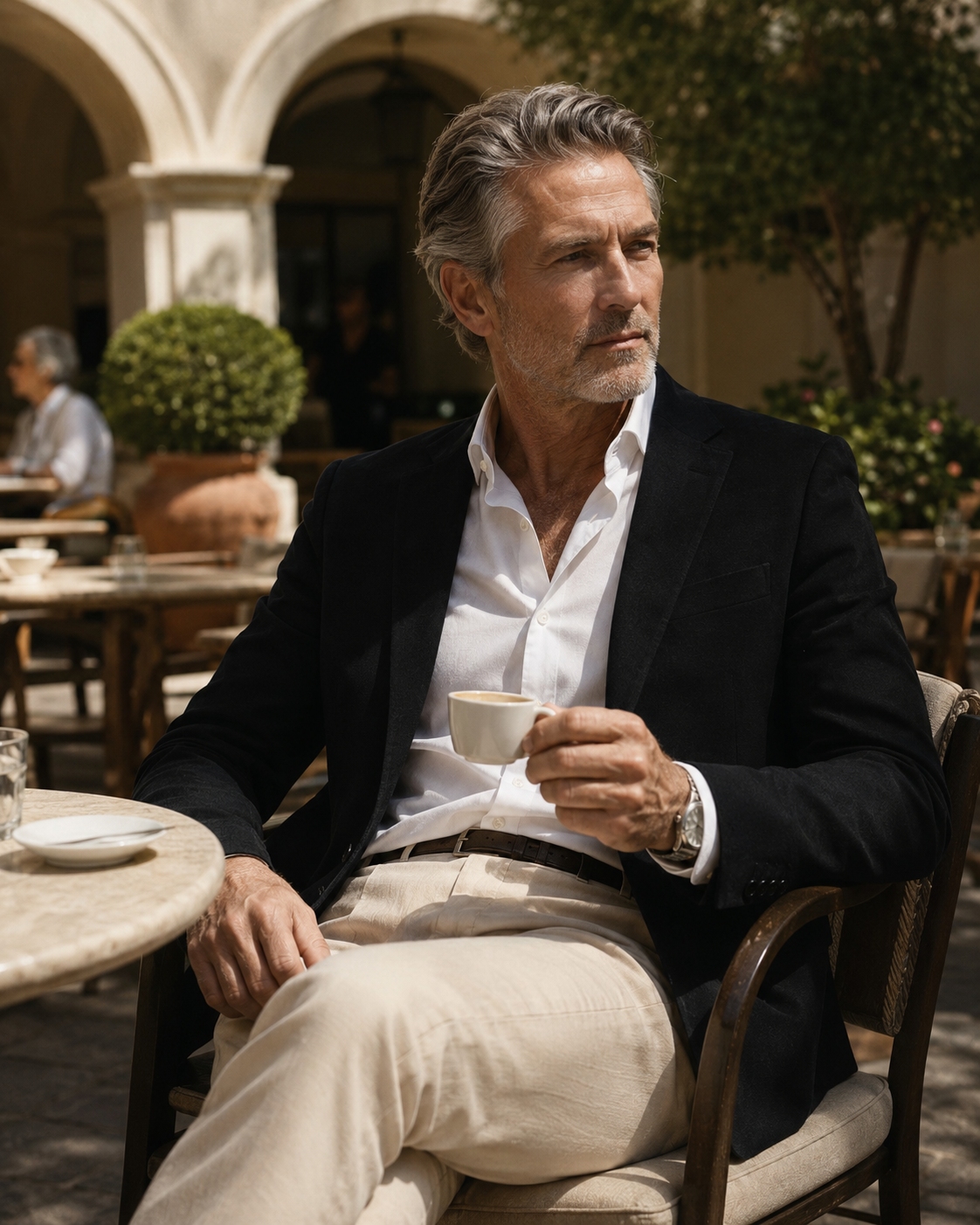
Watch a man who looks sharp at 55. Really watch him.
He is not doing more than the guy next to him. He is making fewer random decisions.
The haircut has a familiar shape, but it changes as his hairline, texture, and face change.
His wardrobe has a dependable core: a few jackets, shirts, trousers, and shoes that fit exactly as they should. New pieces still come in. They just have to earn their place.
His grooming routine is consistent, not frozen. He adjusts it when his skin, hair, or life requires something different, not every time a new product appears.
He still experiments. He just no longer confuses novelty with progress.
He is not necessarily better looking than he was at 35. He is better edited.
And editing does not mean standing still. It means knowing what to keep, what to update, and what to leave behind. I learned that the slow way, watching it happen to other men before I began applying the same lesson to myself.
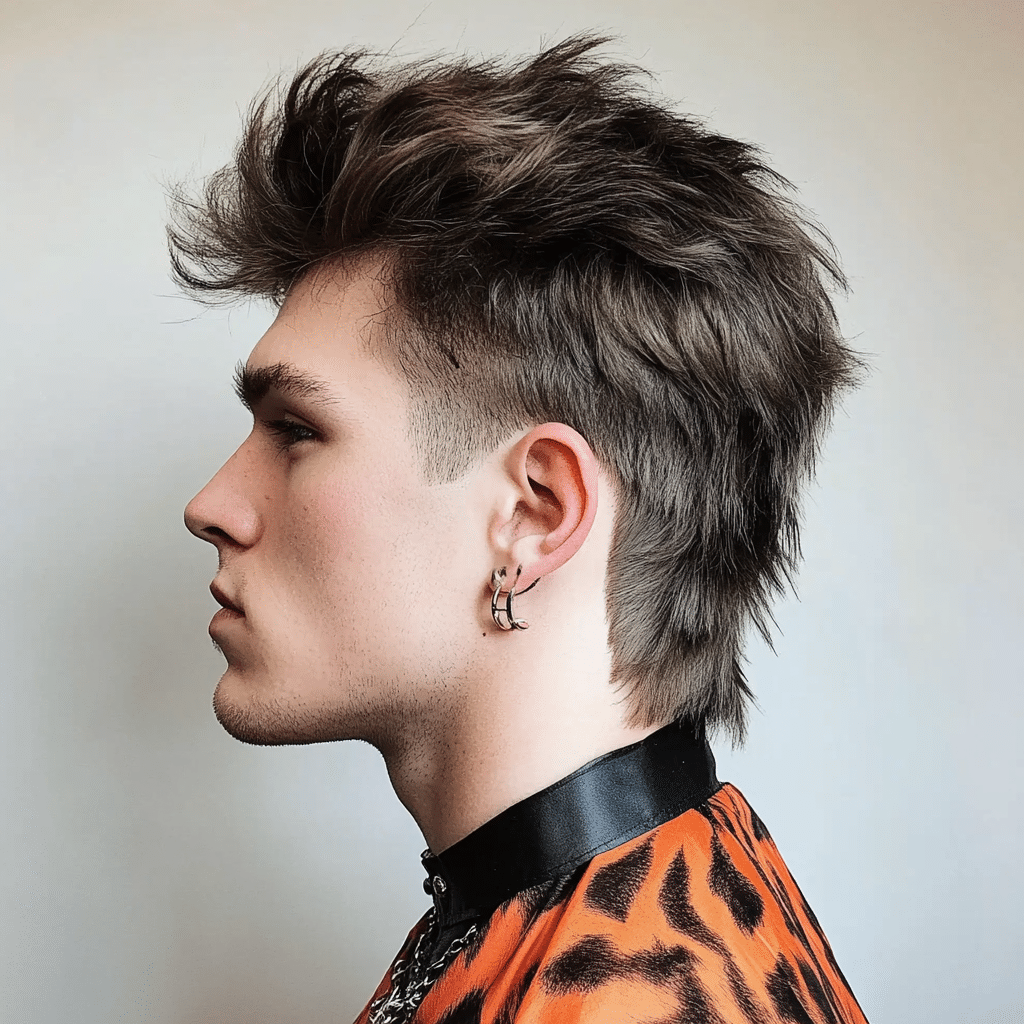
Best Haircuts for Men 2025: Top Trending Styles
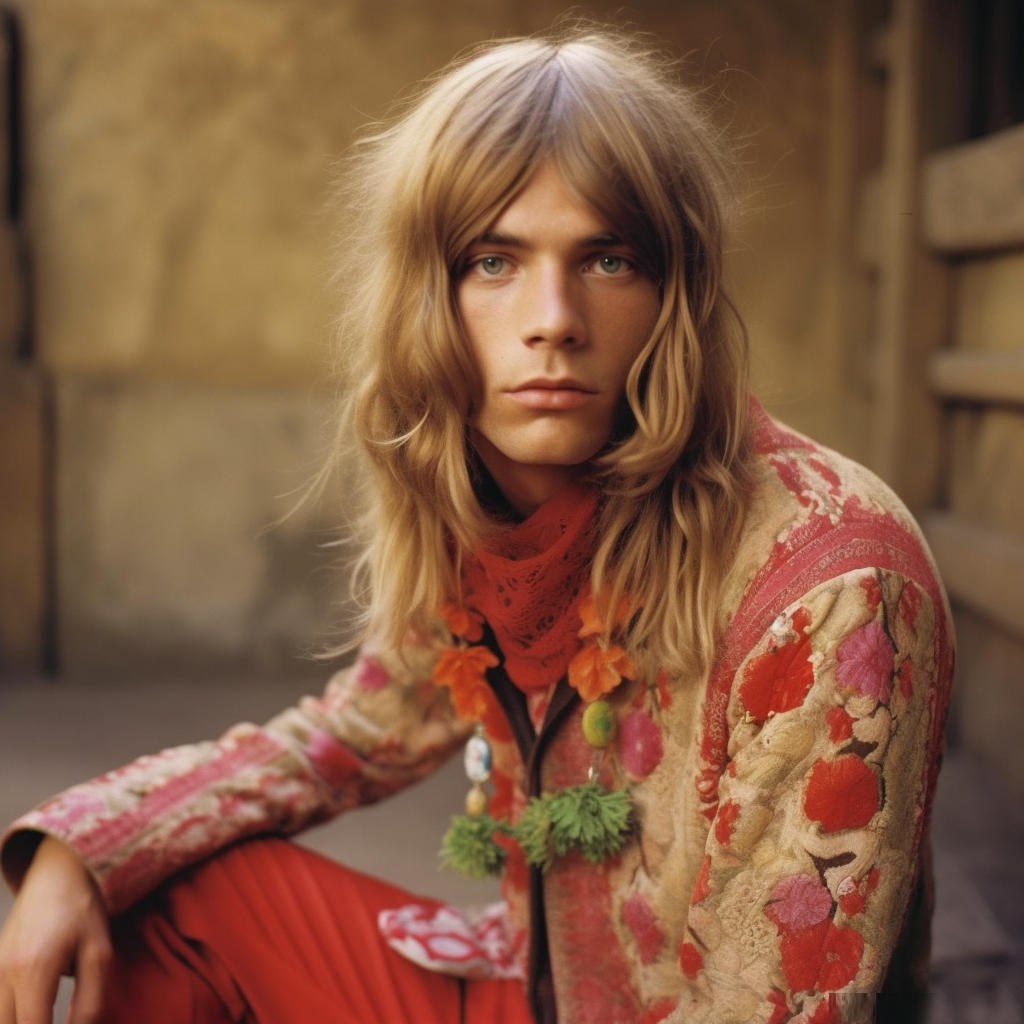
The Free-Spirited Revolution: 1960s Hippie Hairstyles and Haircuts for Men
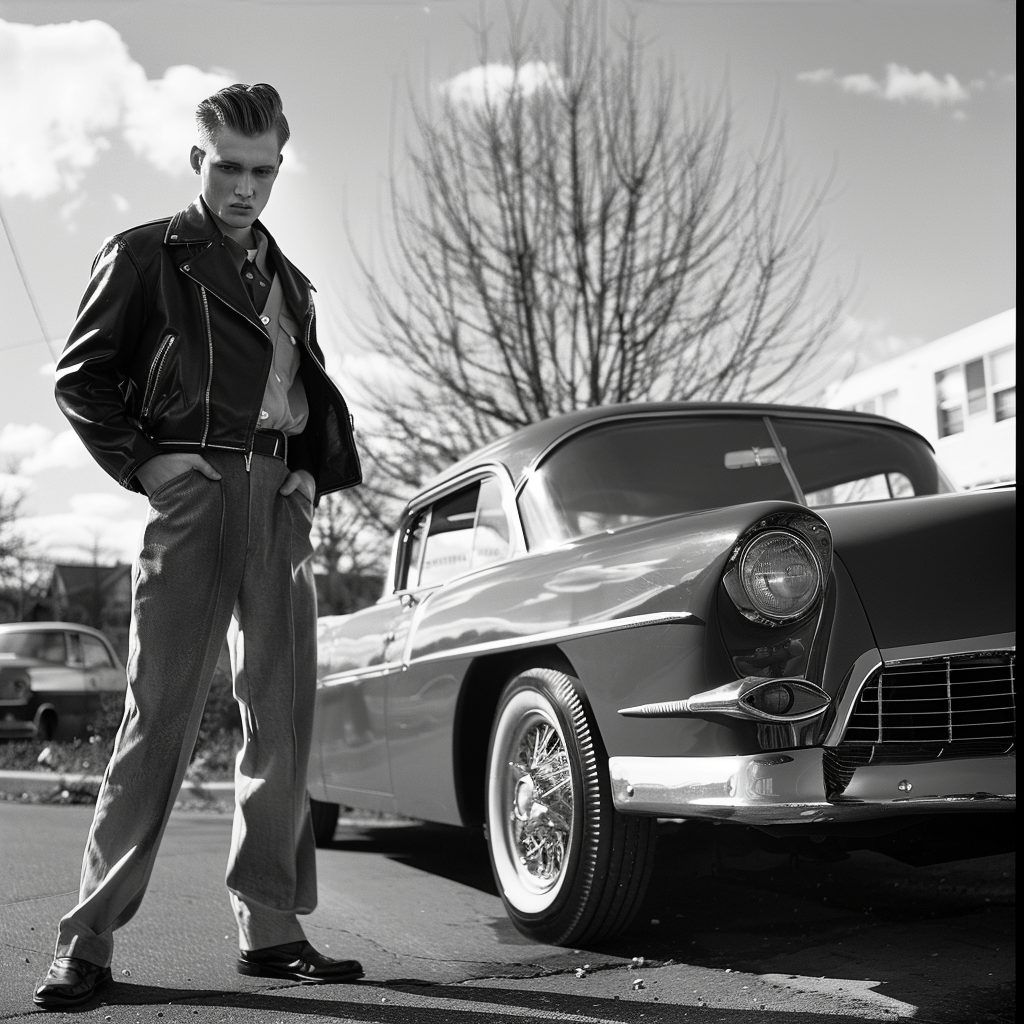
The Evolution of Cars, Men’s Fashion, and Hairstyle Icons – 1950s to 1980s
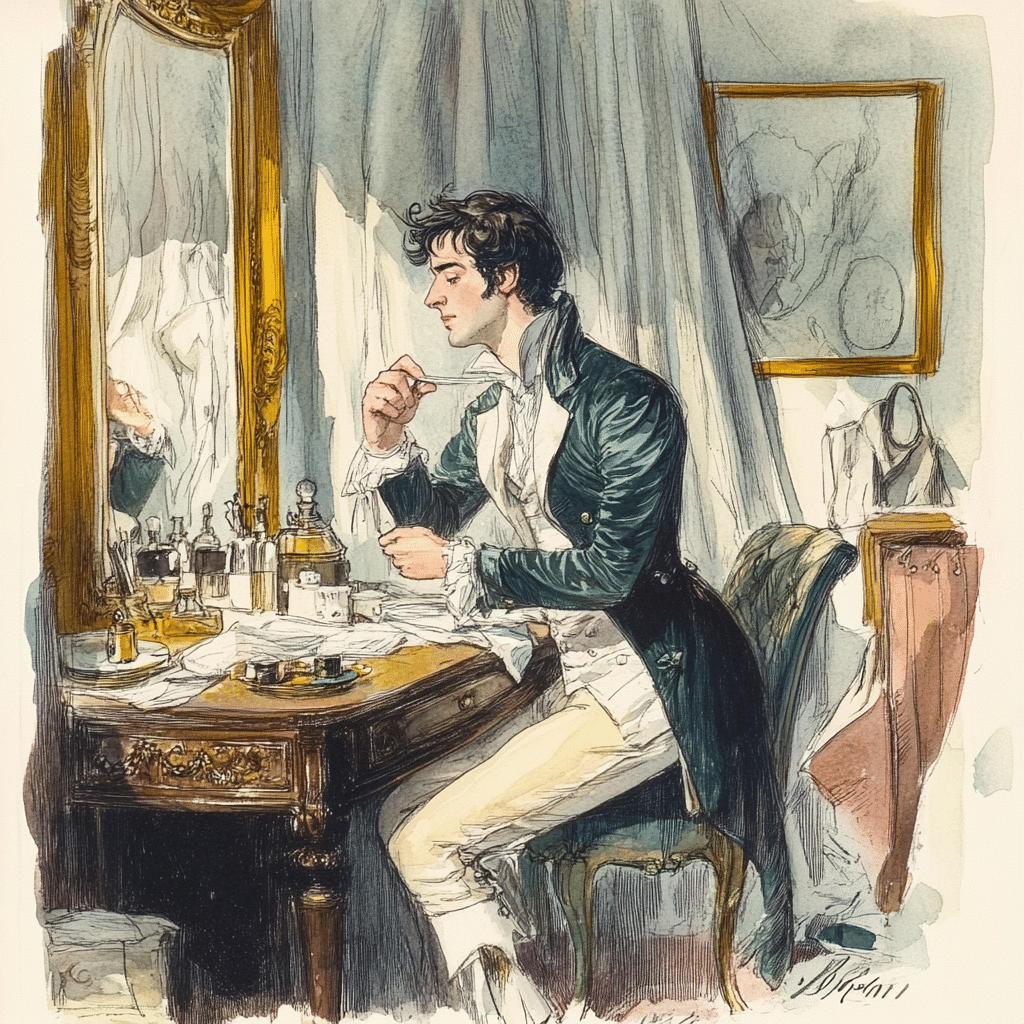
Beau Brummell: The Dandy Who Revolutionized 19th-Century British Men’s Fashion
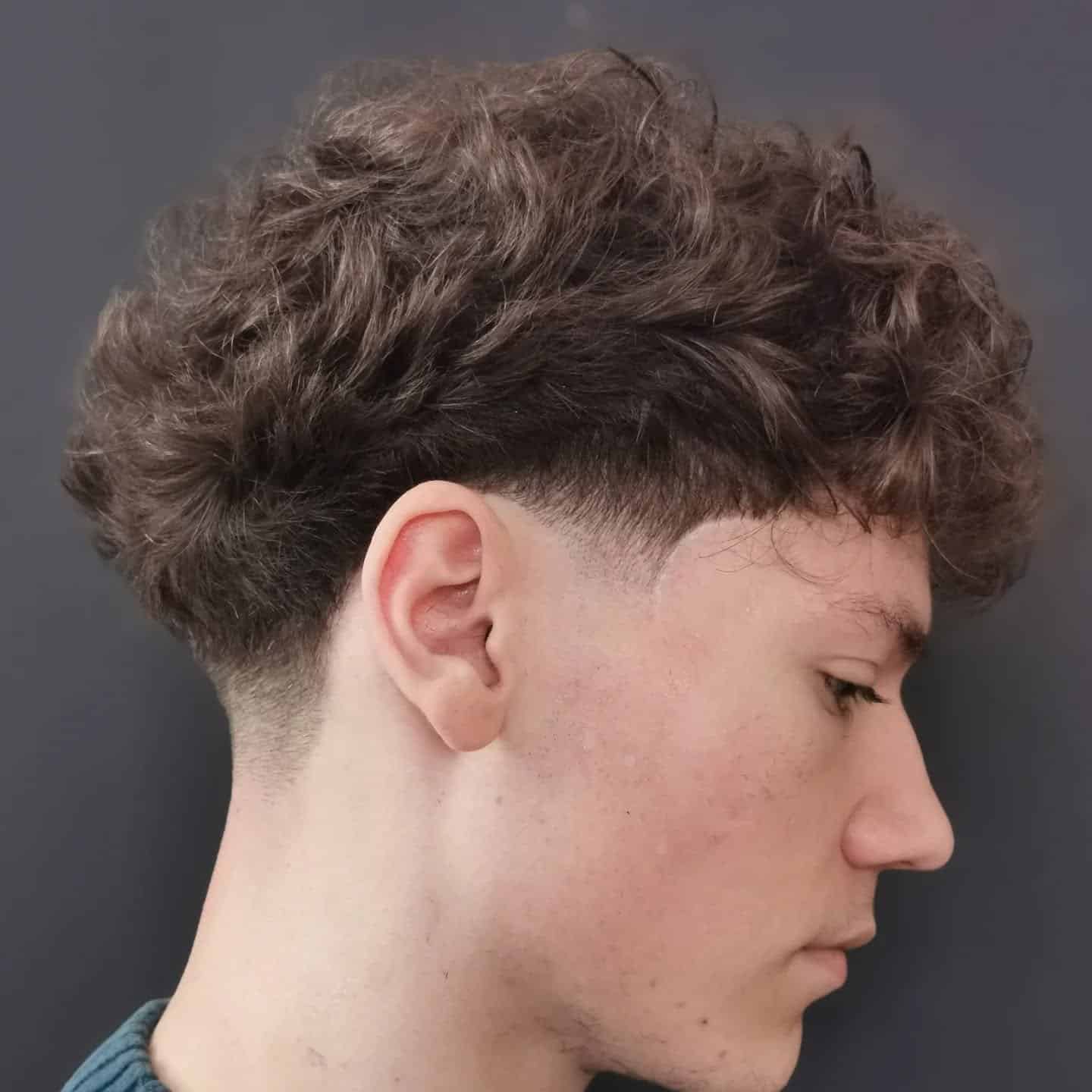
Blowout Taper with Textured Fringe and Other Blowout Styles for Men
![1960s Hairstyles for Men —[some] still on trend today](https://vagazine.com/vaga_v3/wp-content/uploads/2023/01/comparison_of_60s_mens_hairstyles_ivy_league_haircut-1.png)